>
Gobiiformes (Gobies) >
Gobiidae (Gobies) > Gobionellinae
Etymology: Oxyurichthys: Greek, oxys = sharpen + Greek, oura = tail + Greek, ichthys = fish (Ref. 45335).
More on author: Valenciennes.
Environnement : milieu / zone climatique / profondeur / gamme de distribution
Écologie
marin; saumâtre récifal; profondeur 1 - 50 m (Ref. 37816). Tropical
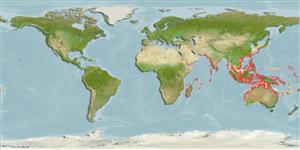
Indo-West Pacific: Red Sea south to Natal, South Africa and east to the tropical west Pacific.
Taille / Poids / Âge
Maturité: Lm ? range ? - ? cm
Max length : 22.0 cm TL mâle / non sexé; (Ref. 127374); poids max. publié: 52.00 g (Ref. 127374)
Description synthétique
Clés d'identification | Morphologie | Morphométrie
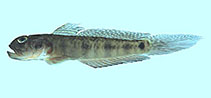
Épines dorsales (Total) : 7; Rayons mous dorsaux (Total) : 12; Épines anales: 1; Rayons mous anaux: 13. Body brown with 7-8 vertical dark brown bars (Ref. 2798); characterized further by pale brownish grey body color with orange spots/bands on cheek and operculum; united pelvic fins, well developed frenum present; long and pointed caudal fin, nearly twice length of head; longitudinal scale series 75-80; ctenoid scales posteriorly to below middle of first dorsal fin, becoming cycloid anteriorly; scales absent on head, midline of nape and prepectoral area; low fleshy ridge on midline of nape; depth of body 5.6-6.5 in SL (Ref. 90102).
Body shape (shape guide): fusiform / normal.
Occurs inshore (Ref. 4343), mud bottoms of estuaries and protected bays (Ref. 37816). Found on open flat bottom and large adults mostly seen at about 30 meters depth. Dives head first into the mud for safety (Ref. 48637). Hides in a burrow, but can dive into mud to escape predators (Ref. 11441).
Cycle de vie et comportement reproducteur
Maturité | Reproduction | Frai | Œufs | Fécondité | Larves
Maugé, L.A., 1986. Gobiidae. p. 358-388. In J. Daget, J.-P. Gosse and D.F.E. Thys van den Audenaerde (eds.) Check-list of the freshwater fishes of Africa (CLOFFA). ISNB, Brussels; MRAC, Tervuren; and ORSTOM, Paris. Vol. 2. (Ref. 4343)
Statut dans la liste rouge de l'IUCN (Ref. 130435: Version 2025-2 (Global))
Menace pour l'homme
Harmless
Utilisations par l'homme
Pêcheries: commercial; Aquarium: Commercial
Outils
Articles particuliers
Télécharger en XML
Sources Internet
Estimations basées sur des modèles
Température préférée (Réf.
123201): 24.6 - 29, mean 27.9 °C (based on 950 cells).
Indice de diversité phylogénétique (Réf.
82804): PD
50 = 0.5000 [Uniqueness, from 0.5 = low to 2.0 = high].
Bayesian length-weight: a=0.00955 (0.00592 - 0.01541), b=2.92 (2.79 - 3.05), in cm total length, based on LWR estimates for this species & (Sub)family-body (Ref.
93245).
Niveau trophique (Réf.
69278): 3.5 ±0.37 se; based on food items.
Résilience (Réf.
120179): Milieu, temps minimum de doublement de population : 1,4 à 4,4 années (Preliminary K or Fecundity.).
Vulnérabilité de la pêche (Ref.
59153): Low vulnerability (12 of 100).
🛈
Nutriments (Ref.
124155): Calcium = 64.2 [34.4, 121.6] mg/100g; Iron = 0.604 [0.305, 1.060] mg/100g; Protein = 18.9 [16.9, 20.5] %; Omega3 = 0.157 [0.075, 0.262] g/100g; Selenium = 24.4 [13.2, 50.3] μg/100g; VitaminA = 112 [31, 365] μg/100g; Zinc = 1.68 [1.18, 2.39] mg/100g (wet weight);