>
Blenniiformes (Blennies) >
Blenniidae (Combtooth blennies) > Salariinae
Etymology: Antennablennius: Latin, antenna, antemna = sensory organ; in Aristotle = horns of insects + Greek, blennios = mucus (Ref. 45335).
More on author: Günther.
Entorno: milieu / zona climática / rango de profundidad / gama de distribución
Ecología
marino demersal; rango de profundidad 18 - 37 m (Ref. 11441). Tropical
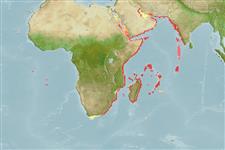
Western Indian Ocean: Mozambique to South Africa (Eastern Cape), Madagascar, Comoros, Aldabra and Mascarenes; not known from Red Sea.
Tamaño / Peso / Edad
Madurez: Lm ? range ? - ? cm
Max length : 7.5 cm TL macho / no sexado; (Ref. 4404)
Descripción breve
Claves de identificación | Morfología | Morfometría
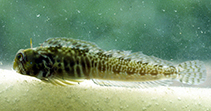
Espinas dorsales (total) : 7; Radios blandos dorsales (total) : 17 - 19; Espinas anales: 2; Radios blandos anales: 17 - 20. The species can be distinguished from Antennablennius persicus by the following characters: number of segmented ray in dorsal fin, 17-18 (vs. 19-20 in A. persicus), anal fins 18-19 (vs. 20); white bars restricted to the ventral half and white spots on the anterior part of body (vs. white narrow bars on the anterior unspotted part of body below spinous portion of the dorsal fin); three black bars ventrally on the head (vs. with a black bar ventrally on the head at angle of mouth (Ref. 132085).
Cross section: oval.
Oviparous. Eggs are demersal and adhesive (Ref. 205), and are attached to the substrate via a filamentous, adhesive pad or pedestal (Ref. 94114). Larvae are planktonic, often found in shallow, coastal waters (Ref. 94114).
Ciclo vital y comportamiento de apareamiento
Madurez | Reproducción | Puesta | Huevos | Fecundidad | Larva
Oviparous, distinct pairing (Ref. 205).
Springer, V.G., 1986. Blenniidae. p. 742-755. In M.M. Smith and P.C. Heemstra (eds.) Smiths' sea fishes. Springer-Verlag, Berlin. (Ref. 4404)
Situación en la Lista Roja de la UICN (Ref. 130435: Version 2025-2 (Global))
Amenaza para el ser humano
Harmless
Usos humanos
Herramientas
Informes especiales
Descargar XML
Fuentes de Internet
Estimaciones basadas en modelos
Temperatura preferida (Referencia
123201): 23.5 - 29, mean 26.7 °C (based on 86 cells).
Índice de diversidad filogenética (Referencia
82804): PD
50 = 0.5020 [Uniqueness, from 0.5 = low to 2.0 = high].
Bayesian length-weight: a=0.00776 (0.00354 - 0.01702), b=3.00 (2.81 - 3.19), in cm total length, based on LWR estimates for this (Sub)family-body shape (Ref.
93245).
Resiliencia (Referencia
120179): Alto, población duplicada en un tiempo mínimo inferior a 15 meses (Preliminary K or Fecundity.).
Vulnerabilidad pesquera (Ref.
59153): Low vulnerability (10 of 100).
🛈