>
Blenniiformes (Blennies) >
Blenniidae (Combtooth blennies) > Salariinae
Etymology: Istiblennius: Greek, istios = sail + Greek, blennios = mucus (Ref. 45335).
More on author: Günther.
Environnement : milieu / zone climatique / profondeur / gamme de distribution
Écologie
marin récifal; profondeur 0 - 3 m (Ref. 30874). Tropical
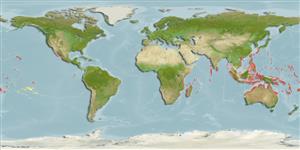
Western Indian Ocean: 3 mi north of Muqadisho, Somalia, south to Bolito Bay, Natal, South Africa; St. Pierrw (Seychelles); Nossi Be, Madagascar, Juan de Nova Island; Mauritius. Eastern Indian Ocean: Christmas Island. Pacific Ocean: New Hebrides, Niuafo'ou, Samoa, Niue, Marquesas, Saipan Islands.
Taille / Poids / Âge
Maturité: Lm ? range ? - ? cm
Max length : 16.0 cm SL mâle / non sexé; (Ref. 4404); 13.1 cm SL (female)
Description synthétique
Clés d'identification | Morphologie | Morphométrie
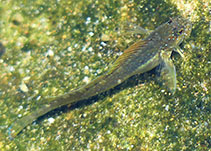
Épines dorsales (Total) : 12 - 14; Rayons mous dorsaux (Total) : 20 - 22; Épines anales: 2; Rayons mous anaux: 20 - 22. Body of males with several paired bands; spots from mouth to nape and posterior part of body; dusky stripes on segmented portion of dorsal fin (Ref. 4404). Females with dusky bands on body; head, body and fins (except pelvic fins) covered with fine dark specs (Ref. 4404).
Body shape (shape guide): fusiform / normal.
Facultative air-breathing (Ref. 126274); Adults are found in intertidal flats and rock shores (Ref. 90102). Oviparous. Eggs are demersal and adhesive (Ref. 205), and are attached to the substrate via a filamentous, adhesive pad or pedestal (Ref. 94114). Larvae are planktonic, often found in shallow, coastal waters (Ref. 94114).
Cycle de vie et comportement reproducteur
Maturité | Reproduction | Frai | Œufs | Fécondité | Larves
Oviparous, distinct pairing (Ref. 205).
Springer, V.G. and J.T. Williams, 1994. The Indo-West Pacific blenniid fish genus Istiblennius reappraised: a revision of Istiblennius, Blenniella, and Paralticus, new genus. Smithson. Contrib. Zool. 565:1-193. (Ref. 9962)
Statut dans la liste rouge de l'IUCN (Ref. 130435: Version 2025-2 (Global))
Menace pour l'homme
Harmless
Utilisations par l'homme
Outils
Articles particuliers
Télécharger en XML
Sources Internet
Estimations basées sur des modèles
Température préférée (Réf.
123201): 24.8 - 29.3, mean 28.3 °C (based on 2052 cells).
Indice de diversité phylogénétique (Réf.
82804): PD
50 = 0.5001 [Uniqueness, from 0.5 = low to 2.0 = high].
Bayesian length-weight: a=0.01047 (0.00463 - 0.02370), b=2.98 (2.79 - 3.17), in cm total length, based on LWR estimates for this (Sub)family-body shape (Ref.
93245).
Niveau trophique (Réf.
69278): 2.0 ±0.00 se; based on food items.
Résilience (Réf.
120179): Milieu, temps minimum de doublement de population : 1,4 à 4,4 années (Preliminary K or Fecundity.).
Vulnérabilité de la pêche (Ref.
59153): Low vulnerability (10 of 100).
🛈