>
Blenniiformes (Blennies) >
Tripterygiidae (Triplefin blennies) > Tripterygiinae
Etymology: Helcogramma: Greek, helkos, -eos, -ous = ulcer, sore + Greek, gramma = letter, mark (Ref. 45335).
More on author: Klunzinger.
Περιβάλλον: περιβάλλον / κλιματική ζώνη / εύρος βάθους / εύρος διανομής
Οικολογία
Θαλασσινό(ά); Υφάλμυρο βενθικό(ς); εύρος βάθους 0 - 30 m (Ref. 5497). Tropical
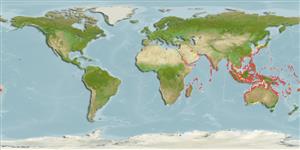
Southeast Atlantic: Ascension Island and St. Helena (Ref. 11441). Indo-West Pacific: Red Sea south to Transkei, South Africa and east to the western Pacific.
Μέγεθος / Βάρος / Ηλικία
Γεννητική Ωρίμανση: Lm ? range ? - ? cm
Max length : 3.8 cm SL αρσενικό/απροσδιόριστο; (Ref. 88983)
Σύντομη περιγραφή
Κλείδες προσδιορισμού | Μορφολογία | Μορφομετρία
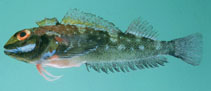
Ραχιαίες άκανθες (συνολικά) : 15 - 18; Μαλακές ραχιαίες ακτίνες (συνολικά) : 9 - 10; Εδρικές άκανθες: 1; Μαλακές εδρικές ακτίνες: 18 - 19; Σπόνδυλοι: 35 - 36. This species is distinguished by the following characters: D III + XII - XIII, 9-10 (usually XIII spines or 10 rays); A I, 18-19 (usually 19); pectoral rays 16 (usually 2, 7, 7). Second dorsal fin twice higher than the first. Lateral line tube scales 20-23 (usually 21-22), extending to the junction of second and third dorsal fins; total lateral scales 36-38 (usually 37-38); transverse scales 7/5. Dentary pores 4 + 1 + 4. Maxilla reaches vertical through centre of pupil; orbital cirrus small and simple. Nape and belly naked; scales do not extend to bases of first dorsal and anterior of anal fins; scale rows 2 on base of caudal fin. Pelvic rays united by membrane for half shorter ray, longest ray reaching vent. Head length 3.3-3.7 (3.5) in SL. Body translucent underwater and green when freshly out of water. Underwater, male head red on upper side and with many melanophores below eyes, extending onto base of pectoral fin; light blue line on cheek with blue patch below; body ‘with H’-bars red and streaks white, belly pinkish-red; dorsal fins translucent with white and red streaks, pelvic and caudal fins pinkish, pectoral fins translucent with red and white marks; females similar to males but overall largely white and without the distinctive pigmentation on the head and belly. Out of water, males overall mottled green, interconnecting areas darker, suffused with dull red dorso-anteriorly, head dark, eye and to branchiostegal membrane black; cheek stripe iridescent blue from lower lip through corner of mouth to preopercle, margin broad black; back saddle patches 4 pale narrow from dorsal fin base to midline, 2 below second dorsal fin and 2 below third dorsal fin; midline spots pale; belly pink; pectoral-fin base with red spot above and below, the lower one bluish anteriorly; pelvic fins dark pink proximally; first dorsal fin dusky with orange tinge, darkest on the margin, and with spot, small black at base of membrane between first and second dorsal fins; dorsal and caudal fins dusky, anal fin evenly dark. Females dull green and paler ventrally, zigzag pattern formed by dark areas; median fins with light sprinkle of pigmentation, first dorsal fin spots small black, basal third of dorsal and entire anal fins white (Ref. 88983). Measurements in %SL: head length 30.2 (26.7-33.6); eye diameter 10.2 (7.8-12.7); seventh pectoral ray 30.6 (26.6-34.1); upper jaw length 13.3 (11.6-15.0); longest pelvic ray 24.2 (19.3-29.4) (Ref. 6211).
Body shape (shape guide): elongated; Cross section: oval.
Adults are found at depths of 6 m and shallower on exposed rocky coasts (Ref. 90102). Eggs are hemispherical and covered with numerous sticky threads that anchor them in the algae on the nesting sites (Ref. 240). Larvae are planktonic which occur primarily in shallow, nearshore waters (Ref. 94114).
Κύκλος ζωής και συμπεριφορά ζευγαρώματος
Γεννητική Ωρίμανση | Αναπαραγωγή | Γεννοβολία | Αβγά | Γονιμότητα | Προνύμφες
Holleman, W. and S.V. Bogorodsky, 2012. A review of the blennioid fish family Tripterygiidae (Perciformes) in the Red Sea, with description of Enneapterygius qirmiz, and reinstatement of Enneapterygius altipinnis Clark, 1980. Zootaxa 3152:36-60. (Ref. 88983)
Κατάσταση Κόκκινου Καταλόγου IUCN (Ref. 130435: Version 2025-2 (Global))
Απειλή για τον άνθρωπο
Harmless
Ανθρώπινες χρήσεις
αλιεία: χωρίς ενδιαφέρον
Εργαλεία
Ειδικές εκθέσεις
Λήψη XML
Διαδικτυακές πηγές
Εκτιμήσεις βάσει μοντέλων
Προτιμώμενη θερμοκρασία (Αναφ.
123201): 23.8 - 29.2, mean 28.4 °C (based on 3393 cells).
Δείκτης φυλογενετικής ποικιλότητας (Αναφ.
82804): PD
50 = 0.5000 [Uniqueness, from 0.5 = low to 2.0 = high].
Bayesian length-weight: a=0.00617 (0.00290 - 0.01310), b=3.04 (2.86 - 3.22), in cm total length, based on LWR estimates for this (Sub)family-body shape (Ref.
93245).
Τροφικό Επίπεδο (Αναφ.
69278): 3.1 ±0.3 se; based on size and trophs of closest relatives
Ελαστικότητα (Αναφ.
120179): Υψηλό, ελάχιστος χρόνος για διπλασιασμό πληθυσμού < 15 μήνες (Preliminary K or Fecundity.).
Ευπάθεια στην αλιεία (Ref.
59153): Low vulnerability (10 of 100).
🛈