>
Eupercaria/misc (Various families in series Eupercaria) >
Sparidae (Porgies)
Etymology: Argyrops: Greek, argyros = silver, silvered + Gree, ops = appearance (Ref. 45335).
Eponymy: Dr Pieter Bleeker (1819–1878) was an ichthyologist and army surgeon commissioned (1841) by the Dutch East India Company. [...] (Ref. 128868), visit book page.
Ambiente: milieu / zona climatica / distribuzione batimetrica / gamma di distribuzione
Ecologia
marino; salmastro demersale; distribuzione batimetrica 50 - 200 m (Ref. 124569). Tropical
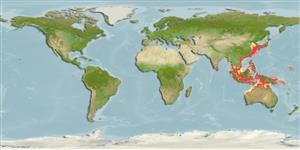
Western Pacific: Japan to Australia.
Dimensione / Peso / Età
Maturità: Lm ? range ? - ? cm
Max length : 50.0 cm SL maschio/sesso non determinato; (Ref. 124569); common length : 30.0 cm SL maschio/sesso non determinato; (Ref. 124569)
Breve descrizione
Chiavi di identificazione | Morfologia | Morfometria
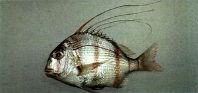
Spine dorsali (totale) : 10 - 11; Raggi dorsali molli (totale) : 9 - 11; Spine anali: 3; Raggi anali molli: 8 - 9. This species is distinguished from all its congeners by the following set of characters: body deep and compressed; D XI,10 (rarely X,11); first dorsal-fin spine rudimentary (one dorsal-fin spine on first dorsal pterygiophore), the second to sixth spines (usually 5, rarely 4) are much elongated and flattened in juveniles 15-25 cm SL (second spine often reaching beyond level of last dorsal soft rays, shorter and reaching first soft dorsal-fin ray base in specimens of ca. 30 cm SL); orbit diameter clearly less than suborbital depth; pupil diameter greater than preorbital length in specimens less than 20 cm SL, but pupil diameter is clearly less than preorbital length (more noticeable in specimens greater than approx. 30 cm SL; the rear margin of upper jaw extends to a vertical beyond orbit diameter; body bars reddish, often present to 25 cm SL; all fins reddish hyaline (Ref. 124569).
Cross section: compressed.
Inhabits sandy and muddy bottoms (Ref. 41299). Important food fish. In Okinawa (Japan), according to local fishermen, this species usually reches more thatn 50 cm SL and a buyer from Ryukyu Is. reported that some individuals occasionally attain 65 cm SL (Ref. 124569).
Ciclo vitale e comportamento di accoppiamento
Maturità | Riproduzione | Deposizione | Uova | Fecondità | Larve
Iwatsuki, Y. and P.C. Heemstra, 2018. Taxonomic review of the genus Argyrops (Perciformes; Sparidae) with three new species from the Indo-West Pacific. Zootaxa 4438(3):401-442. (Ref. 124569)
Stato della Lista Rossa IUCN (Ref. 130435: Version 2025-2 (Global))
Minaccia per l'uomo
Harmless
Usi umani
Pesca: commerciale
Strumenti
Rapporti speciali
Scarica XML
Fonti Internet
Stime basate su modelli
Temperatura preferita (Fonte Biblio.
123201): 17.4 - 28.2, mean 26.4 °C (based on 780 cells).
Indice di diversità filogenetica (Fonte Biblio.
82804): PD
50 = 0.5078 [Uniqueness, from 0.5 = low to 2.0 = high].
Bayesian length-weight: a=0.01995 (0.00935 - 0.04259), b=2.97 (2.80 - 3.14), in cm total length, based on LWR estimates for this (Sub)family-body shape (Ref.
93245).
Livello trofico (Fonte Biblio.
69278): 4.5 ±0.8 se; based on diet studies.
Resilienza (Fonte Biblio.
120179): Basso, tempo minimo di raddoppiamento della popolazione 4.5 - 14 anni (Preliminary K or Fecundity.).
Vulnerabilità della pesca (Ref.
59153): Moderate vulnerability (44 of 100).
🛈