>
Polypteriformes (Bichirs) >
Polypteridae (Bichirs)
Etymology: Polypterus: Greek, poly = a lot of + Greek, pteron = wing, fin (Ref. 45335); delhezi: Named after M. Delhez, collector of the first specimen of Polypterus delhezi (Ref. 1877).
Eponymy: Henri Paul Delhez (1870–1900) was a Belgian artist and naturalist who made collections of fishes in the Congo, and whose field observations Boulenger found most useful in the preparation of his book on Congo fishes. (Ref. 128868), visit book page.
More on author: Boulenger.
Entorno: milieu / zona climática / rango de profundidad / gama de distribución
Ecología
; agua dulce demersal. Tropical; 26°C - 28°C (Ref. 2060)
Africa: middle Congo River basin (Ref. 3188) in Democratic Republic of the Congo and Republic of Congo. Reports from the Shari (Chad basin)(Ref. 1878, 3047, 3049) unconfirmed in Ref. 81263.
Tamaño / Peso / Edad
Madurez: Lm ? range ? - ? cm
Max length : 44.0 cm TL macho / no sexado; (Ref. 42908)
Descripción breve
Claves de identificación | Morfología | Morfometría
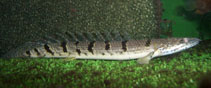
Espinas dorsales (total) : 10 - 13; Espinas anales: 0; Radios blandos anales: 11 - 14. Subcylindrical body (Ref. 42908). Upper and lower jaws reaching to the same level, or the lower jaw is a little shorter (Ref. 42873, Ref. 42901, Ref. 42908). Number of dorsal finlets: 10-13 (Ref. 42908, Ref. 51884). Pectoral fin not reaching dorsal fin origin (Ref. 41588). Ganoid scales (Ref. 42908): 52-58 lateral line scales, 36-40 scales around body, 12-17 predorsal scales (Ref. 41588, Ref. 42848, Ref. 42908, Ref. 51884). Dorsal side gray-olive colored, with 7 to 8 black transversal bars; ventral side yellowish, lighter on ventral side of head (Ref. 41580; Ref. 44841). Spots are forming a black line between the lips and suboperculum (Ref. 41580). Fins yellow with brown or black spots (Ref. 41580).
Body shape (shape guide): elongated; Cross section: circular.
Facultative air-breathing (Ref. 126274); This carnivorous fish lives in streams, lakes and zones of flood (Ref. 41580). Reproduction and spawning occurs during the rainy season (Ref. 41580).
Ciclo vital y comportamiento de apareamiento
Madurez | Reproducción | Puesta | Huevos | Fecundidad | Larva
Reproduction occurs during the rainy season (Ref. 41580).
Robins, C.R., R.M. Bailey, C.E. Bond, J.R. Brooker, E.A. Lachner, R.N. Lea and W.B. Scott, 1991. World fishes important to North Americans. Exclusive of species from the continental waters of the United States and Canada. Am. Fish. Soc. Spec. Publ. (21):243 p. (Ref. 4537)
Situación en la Lista Roja de la UICN (Ref. 130435: Version 2025-2 (Global))
Amenaza para el ser humano
Harmless
Usos humanos
Pesquerías: pesquerías de subsistencia; Acuario: Acuarios públicos
Herramientas
Informes especiales
Descargar XML
Fuentes de Internet
Estimaciones basadas en modelos
Índice de diversidad filogenética (Referencia
82804): PD
50 = 0.5003 [Uniqueness, from 0.5 = low to 2.0 = high].
Bayesian length-weight: a=0.00457 (0.00194 - 0.01077), b=3.05 (2.85 - 3.25), in cm total length, based on LWR estimates for this (Sub)family-body shape (Ref.
93245).
Nivel trófico (Referencia
69278): 3.2 ±0.25 se; based on food items.
Resiliencia (Referencia
120179): Bajo, población duplicada en un tiempo mínimo de 4.5-14 años (Fec=2,350; tmax likely > 15 years).
Vulnerabilidad pesquera (Ref.
59153): Low to moderate vulnerability (34 of 100).
🛈