>
Characiformes (Characins) >
Acestrorhamphidae (American tetras) > Megalamphodinae
Etymology: Paracheirodon: Greek, para = the side of + Greek, cheir = hand + Greek, odous = teeth (Ref. 45335).
Eponymy: Dr Herbert Richard Axelrod (1927–2017) was an expert on tropical fishes, an entrepreneur and a publisher of pet books. [...] (Ref. 128868), visit book page.
More on author: Schultz.
Taxonomic Remarks
Synonym, redescription, figures and discussion of type locality in Weitzman & Fink (1983)
Environnement : milieu / zone climatique / profondeur / gamme de distribution
Écologie
; eau douce pélagique; pH range: 4.0 - 6.0; dH range: 5 - 12; non migrateur. Tropical; 23°C - 27°C (Ref. 1672)
South America: Upper Orinoco and Negro River basins.
Taille / Poids / Âge
Maturité: Lm ? range ? - ? cm
Max length : 3.0 cm SL mâle / non sexé; (Ref. 137577)
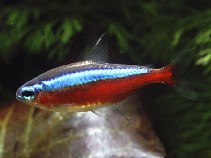
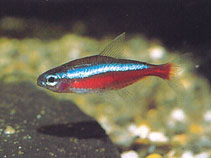
Occurs mainly in shoals in the middle water layers. Feeds on worms and small crustaceans (Ref. 7020). Breeding in captivity is possible but difficult and most specimens in the aquarium trade are caught in the tributaries of the Rio Negro and Orinoco. Eggs hatch in 24 to 30 hours and fry are free-swimming after 3 to 4 days in captivity (Ref. 7020). One of the most popular and beautiful aquarium fishes. Aquarium keeping: in groups of 5 or more individuals; minimum aquarium size 60 cm (Ref. 51539).
Cycle de vie et comportement reproducteur
Maturité | Reproduction | Frai | Œufs | Fécondité | Larves
Lima, F.C.T., L.R. Malabarba, P.A. Buckup, J.F. Pezzi da Silva, R.P. Vari, A. Harold, R. Benine, O.T. Oyakawa, C.S. Pavanelli, N.A. Menezes, C.A.S. Lucena, M.C.S.L. Malabarba, Z.M.S. Lucena, R.E. Reis, F. Langeani, C. Moreira et al. …, 2003. Genera Incertae Sedis in Characidae. p. 106-168. In R.E. Reis, S.O. Kullander and C.J. Ferraris, Jr. (eds.) Checklist of the Freshwater Fishes of South and Central America. Porto Alegre: EDIPUCRS, Brasil. (Ref. 38376)
Statut dans la liste rouge de l'IUCN (Ref. 130435: Version 2025-2 (Global))
Menace pour l'homme
Harmless
Utilisations par l'homme
Pêcheries: hautement commercial; Aquarium: hautement commercial
Outils
Articles particuliers
Télécharger en XML
Sources Internet
Estimations basées sur des modèles
Indice de diversité phylogénétique (Réf.
82804): PD
50 = 0.6250 [Uniqueness, from 0.5 = low to 2.0 = high].
Bayesian length-weight: a=0.01122 (0.00447 - 0.02817), b=3.07 (2.86 - 3.28), in cm total length, based on LWR estimates for this (Sub)family-body shape (Ref.
93245).
Niveau trophique (Réf.
69278): 3.3 ±0.39 se; based on food items.
Résilience (Réf.
120179): Haut, temps minimum de doublement de population inférieur à 15 mois (tm<1).
Vulnérabilité de la pêche (Ref.
59153): Low vulnerability (10 of 100).
🛈