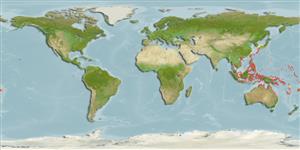
Environnement : milieu / zone climatique / profondeur / gamme de distribution
Écologie
marin; eau douce; saumâtre démersal; amphidrome (Ref. 59012); profondeur 0 - 2 m (Ref. 11890). Tropical
Indo-Pacific
Taille / Poids / Âge
Maturité: Lm ? range ? - ? cm
Max length : 17.0 cm TL mâle / non sexé; (Ref. 7050)
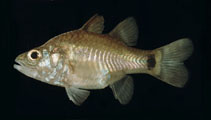
Épines dorsales (Total) : 7; Rayons mous dorsaux (Total) : 9; Épines anales: 2; Rayons mous anaux: 8. Trunk rhombic, mid body below the 1st dorsal base high. Nape moderately concave, snout tip rounded. Maxillary reaching rear border of eye. A distinct black spot just in front of anal base about equal to eye diameter in width.
Body shape (shape guide): short and / or deep; Cross section: compressed.
Adults inhabit mangrove estuaries, tidal creeks and lower reaches of freshwater streams (Ref. 44894). Usually found in brackish water or freshwater of river mouths. Nocturnal (Ref. 7300), euryhaline species (Ref. 59012).
Cycle de vie et comportement reproducteur
Maturité | Reproduction | Frai | Œufs | Fécondité | Larves
Mouthbrooders (Ref. 240). Distinct pairing during courtship and spawning (Ref. 205).
Masuda, H., K. Amaoka, C. Araga, T. Uyeno and T. Yoshino, 1984. The fishes of the Japanese Archipelago. Vol. 1. Tokai University Press, Tokyo, Japan. 437 p. (text). (Ref. 559)
Statut dans la liste rouge de l'IUCN (Ref. 130435: Version 2025-2 (Global))
Menace pour l'homme
Harmless
Utilisations par l'homme
Outils
Articles particuliers
Télécharger en XML
Sources Internet
Estimations basées sur des modèles
Température préférée (Réf.
123201): 25.4 - 29.3, mean 28.8 °C (based on 1559 cells).
Indice de diversité phylogénétique (Réf.
82804): PD
50 = 1.0000 [Uniqueness, from 0.5 = low to 2.0 = high].
Bayesian length-weight: a=0.01479 (0.00888 - 0.02463), b=3.16 (3.02 - 3.30), in cm total length, based on LWR estimates for this species & (Sub)family-body (Ref.
93245).
Niveau trophique (Réf.
69278): 3.6 ±0.4 se; based on diet studies.
Résilience (Réf.
120179): Haut, temps minimum de doublement de population inférieur à 15 mois (Preliminary K or Fecundity.).
Vulnérabilité de la pêche (Ref.
59153): Low vulnerability (10 of 100).
🛈