Umwelt: Milieu / Klimazone / Tiefenbereich / Verbreitungsgebiet
Ökologie
seewasser riff-verbunden; tiefenbereich 5 - 25 m (Ref. 9324). Tropical
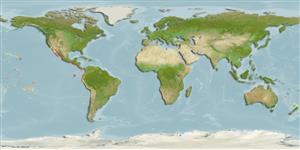
Eastern Pacific: Gulf of California to Islas Lobos de Afuera, Peru, including the Galapagos Islands.
Größe / Gewicht / Alter
Geschlechtsreife: Lm ? range ? - ? cm
Max length : 61.0 cm TL Männchen/unbestimmt; (Ref. 5590); common length : 35.0 cm TL Männchen/unbestimmt; (Ref. 57763)
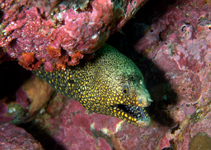
Head and jaws very much compressed; body tapering posteriorly. Body depth at the middle about 1/13 of the entire length; the head about 1/7, measured to the branchial orifice. Jaws very narrow, sharp-pointed and equal. Gape deeply cleft. Teeth compressed at the sides, very sharp, slightly hooked and pointing backwards. Two tubular orifices above the eyes and two at the extremity of the snout. Distance of eyes from the end of the snout about twice the eye diameter. Branchial orifice and eyes of same size. Dorsal fin thick and fleshy. Color is fine dark purplish brown, with yellow circular spots; the spots mostly small. (Ref. 3157).
Body shape (shape guide): eel-like.
Often seen in shallow water. Remains under cover in rocky crevices during the day. Feeds mainly at night on crustaceans and fishes (Ref. 6852). Constantly opens and closes it mouth, an action required for respiration, not a threat (Ref. 5227).
Lebenszyklus und Paarungsverhalten
Geschlechtsreife | Fortpflanzung | Ablaichen | Eier | Fruchtbarkeit | Larven
Merlen, G., 1988. A field guide to the fishes of Galapagos. Wilmot Books, London, England 60 p. (Ref. 5590)
IUCN Rote Liste Status (Ref. 130435: Version 2025-2 (Global))
Bedrohung für Menschen
Harmless
Nutzung durch Menschen
Tools
Zusatzinformationen
Download XML
Internet Quellen
Schätzungen auf der Grundlage von Modellen
Bevorzugte Temperatur (Ref.
123201): 22.3 - 29.1, mean 26.7 °C (based on 244 cells).
Phylogenetischer Diversitätsindex (Ref.
82804): PD
50 = 0.5010 [Uniqueness, from 0.5 = low to 2.0 = high].
Bayesian length-weight: a=0.00049 (0.00024 - 0.00099), b=3.26 (3.09 - 3.43), in cm total length, based on LWR estimates for this (Sub)family-body shape (Ref.
93245).
Trophische Ebene (Ref.
69278): 3.9 ±0.61 se; based on food items.
Widerstandsfähigkeit (Ref.
120179): mittel, Verdopplung der Population dauert 1,4 - 4,4 Jahre. (Preliminary K or Fecundity.).
Anfälligkeit der Fischerei (Ref.
59153): Moderate vulnerability (44 of 100).
🛈
Nährstoffe (Ref.
124155): Calcium = 39.1 [21.5, 70.3] mg/100g; Iron = 0.476 [0.287, 0.993] mg/100g; Protein = 18.8 [16.5, 21.3] %; Omega3 = 0.105 [0.047, 0.293] g/100g; Selenium = 34.1 [19.2, 69.0] μg/100g; VitaminA = 75.8 [22.5, 227.7] μg/100g; Zinc = 1.02 [0.73, 1.41] mg/100g (wet weight);