>
Scombriformes (Mackerels) >
Trichiuridae (Cutlassfishes) > Lepidopodinae
Etymology: Eupleurogrammus: Greek, eu = good + Greek, pleura = near, on the side + Greek, gramma = mark, signal (Ref. 45335).
More on author: Gray.
Entorno: milieu / zona climática / rango de profundidad / gama de distribución
Ecología
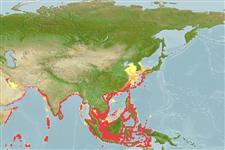
marino; salobre bentopelágico; rango de profundidad 0 - 80 m (Ref. 6181). Tropical; 41°N - 11°S, 47°E - 135°E (Ref. 6181)
Indo-West Pacific: including the Persian Gulf, India, Sri Lanka, Malaysia, Indonesia, Gulf of Thailand, China and southern Korean Peninsula.
Tamaño / Peso / Edad
Madurez: Lm ? range ? - ? cm
Max length : 87.0 cm TL macho / no sexado; (Ref. 112044); 97.5 cm (female); common length : 50.0 cm TL macho / no sexado; (Ref. 9688)
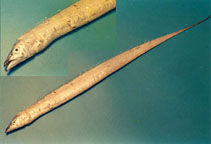
Espinas dorsales (total) : 3; Radios blandos dorsales (total) : 140. Body extremely elongate, compressed and tapering to a point. Anal fin reduced to minute spinules buried in skin; caudal fin absent; pelvic fins present but reduced to a scale-like process. Lateral line running almost straight along midbody or slightly nearer the ventral contour. Color of fresh specimens steely blue with metallic reflections, becoming silvery gray after death.
Body shape (shape guide): elongated; Cross section: compressed.
Inhabits coastal waters and often comes near the surface at night. Enters estuaries (Ref. 1479). Feeds on a wide variety of small fishes, squids and crustaceans. Marketed mainly in dried and salted forms (sometimes fresh), mixed with other trichiurids. Caught mainly with shore seines, bag nets and coastal bottom trawls in coastal waters down to about 50 m in West Bengal to Madras and around Bombay of India.
Ciclo vital y comportamiento de apareamiento
Madurez | Reproducción | Puesta | Huevos | Fecundidad | Larva
Nakamura, I. and N.V. Parin, 1993. FAO Species Catalogue. Vol. 15. Snake mackerels and cutlassfishes of the world (families Gempylidae and Trichiuridae). An annotated and illustrated catalogue of the snake mackerels, snoeks, escolars, gemfishes, sackfishes, domine, oilfish, cutlassfishes,. scabbardfishes, hairtails, and frostfishes known to date. FAO Fish. Synop. 125(15):136 p. (Ref. 6181)
Situación en la Lista Roja de la UICN (Ref. 130435: Version 2025-2 (Global))
Amenaza para el ser humano
Harmless
Usos humanos
Pesquerías: comercial
Herramientas
Informes especiales
Descargar XML
Fuentes de Internet
Estimaciones basadas en modelos
Temperatura preferida (Referencia
123201): 24.3 - 29.1, mean 28.4 °C (based on 1170 cells).
Índice de diversidad filogenética (Referencia
82804): PD
50 = 0.7500 [Uniqueness, from 0.5 = low to 2.0 = high].
Bayesian length-weight: a=0.00033 (0.00020 - 0.00054), b=3.20 (3.06 - 3.34), in cm total length, based on LWR estimates for this species & (Sub)family-body (Ref.
93245).
Nivel trófico (Referencia
69278): 4.1 ±0.7 se; based on diet studies.
Resiliencia (Referencia
120179): Alto, población duplicada en un tiempo mínimo inferior a 15 meses (Preliminary K or Fecundity.).
Vulnerabilidad pesquera (Ref.
59153): Moderate to high vulnerability (48 of 100).
🛈
Nutrientes (Ref.
124155): Calcium = 96.2 [48.9, 173.9] mg/100g; Iron = 0.923 [0.467, 1.688] mg/100g; Protein = 17.8 [16.3, 19.4] %; Omega3 = 0.162 [0.081, 0.352] g/100g; Selenium = 85.5 [42.2, 182.5] μg/100g; VitaminA = 17.8 [5.0, 50.9] μg/100g; Zinc = 0.981 [0.667, 1.547] mg/100g (wet weight);