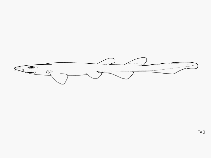
Elasmobranquios (tiburones y rayas) (sharks and rays) >
Carcharhiniformes (Ground sharks) >
Dichichthyidae (Bristle shark)
Etymology: Dichichthys: Name from the combination of the Greek 'dicho'- meaning 'to branch in two' and 'ichthys' for 'fish', with this genus being intermediate between the Galeus-Parmaturus complex and Apristurus; melanobranchus: melanos (Gr.), black; branchos (Gr.), gill, referring to blackish color on gill septa (See ETYFish).
Entorno: milieu / zona climática / rango de profundidad / gama de distribución
Ecología
marino batidemersal; rango de profundidad 540 - 810 m (Ref. 244). Deep-water; 21°N - 18°N
Northwest Pacific: known from only 3 specimens taken in the South China Sea. Collected less than a degree north of the northwestern boundary of the Western Central Pacific (Ref. 11146).
Tamaño / Peso / Edad
Madurez: Lm ? range ? - ? cm
Max length : 85.0 cm TL (female)
Espinas dorsales (total) : 0; Espinas anales: 0. Light brown with distal parts and anterior margins of fins, snout, nostrils, and gills blackish brown in young, possibly uniform blackish brown in adults (Ref. 11146).
Body shape (shape guide): elongated.
A poorly known deep-water bottom-dwelling catshark found on mud bottoms of the upper continental slopes (Ref. 11146). Oviparous (Ref. 130868).
Ciclo vital y comportamiento de apareamiento
Madurez | Reproducción | Puesta | Huevos | Fecundidad | Larva
Oviparous, paired eggs are laid. Embryos feed solely on yolk (Ref. 50449).
White, W.T., A.L. Stewart, H.L. O’Neill and G.J.P. Naylor, 2024. Dichichthyidae, a new family of deepwater sharks (Carcharhiniformes) from the Indo–West Pacific, with description of a new species. Fishes 2024, 9, 121. (Ref. 130868)
Situación en la Lista Roja de la UICN (Ref. 130435: Version 2025-2 (Global))
Amenaza para el ser humano
Harmless
Usos humanos
Pesquerías: sin interés
Herramientas
Informes especiales
Descargar XML
Fuentes de Internet
Estimaciones basadas en modelos
Índice de diversidad filogenética (Referencia
82804): PD
50 = 0.5625 [Uniqueness, from 0.5 = low to 2.0 = high].
Bayesian length-weight: a=0.00389 (0.00180 - 0.00842), b=3.12 (2.94 - 3.30), in cm total length, based on all LWR estimates for this body shape (Ref.
93245).
Nivel trófico (Referencia
69278): 4.0 ±0.5 se; based on size and trophs of closest relatives
Resiliencia (Referencia
120179): Bajo, población duplicada en un tiempo mínimo de 4.5-14 años (Fec assumed to be <100).
Vulnerabilidad pesquera (Ref.
59153): Moderate to high vulnerability (54 of 100).
🛈