Ambiente: milieu / zona climatica / distribuzione batimetrica / gamma di distribuzione
Ecologia
marino; acqua dolce; salmastro pelagic-neritic; potamodromo (Ref. 51243); distribuzione batimetrica 0 - ? m. Tropical
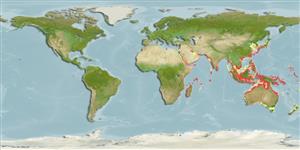
Indo-West Pacific: Persian Gulf to China along the mainland coast of Asia. Replaced in the East Indies, Borneo, and the Philippines by Hyporhamphus neglectus and around northern Australia and southern New Guinea by Hyporhamphus neglectissimus.
Lunghezza alla prima maturità / Dimensione / Peso / Età
Maturità: Lm ?, range 9 - ? cm
Max length : 35.0 cm TL maschio/sesso non determinato; (Ref. 85009); common length : 13.0 cm SL maschio/sesso non determinato; (Ref. 9843)
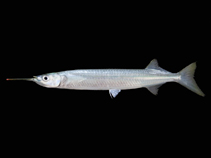
Spine dorsali (totale) : 0; Raggi dorsali molli (totale) : 13 - 16; Spine anali: 0; Raggi anali molli: 13 - 16. Greatly prolonged, beak-like lower jaw, equal to, or longer than head length; upper jaw short, triangular and scaly, its width 0.6-0.8 times in its length. Preorbital distance 1.3-2.1 times in diameter of orbit and 0.75-1.2 times in length of upper jaw. Total number of gill rakers on first gill arch 23-37. Anal fin rays 13-16; caudal fin emarginate, not strongly forked.
Body shape (shape guide): elongated.
Coastal species. Found at surface levels of tidal freshwaters and brackish estuaries (Ref. 12693). Encountered in the Mekong as far upstream as Stung Treng and also found in the Great Lake, Cambodia (Ref. 12693). Feed mainly on insects (Ref. 12693, 33813). Marketed fresh and dried salted.
Ciclo vitale e comportamento di accoppiamento
Maturità | Riproduzione | Deposizione | Uova | Fecondità | Larve
Collette, B.B. and J. Su, 1986. The halfbeaks (Pisces, Beloniformes, Hemiramphidae) of the Far East. Proc. Acad. Nat. Sci. Philadelphia 138(1):250-301. (Ref. 10943)
Stato della Lista Rossa IUCN (Ref. 130435: Version 2025-2 (Global))
Minaccia per l'uomo
Harmless
Usi umani
Pesca: scarso interesse commerciale
Strumenti
Rapporti speciali
Scarica XML
Fonti Internet
Stime basate su modelli
Temperatura preferita (Fonte Biblio.
123201): 24.8 - 29.2, mean 28.3 °C (based on 1334 cells).
Indice di diversità filogenetica (Fonte Biblio.
82804): PD
50 = 0.5000 [Uniqueness, from 0.5 = low to 2.0 = high].
Bayesian length-weight: a=0.00427 (0.00257 - 0.00707), b=3.06 (2.92 - 3.20), in cm total length, based on LWR estimates for this species & Genus-body shape (Ref.
93245).
Livello trofico (Fonte Biblio.
69278): 3.1 ±0.1 se; based on diet studies.
Resilienza (Fonte Biblio.
120179): Alto, tempo minimo di raddoppiamento della popolazione meno di 15 mesi (Preliminary K or Fecundity.).
Vulnerabilità della pesca (Ref.
59153): Low vulnerability (25 of 100).
🛈
Nutrienti (Ref.
124155): Calcium = 626 [155, 1,421] mg/100g; Iron = 1.71 [0.67, 4.68] mg/100g; Protein = 17.9 [15.1, 20.0] %; Omega3 = 0.204 [0.090, 0.592] g/100g; Selenium = 29 [12, 63] μg/100g; VitaminA = 68.8 [19.4, 231.8] μg/100g; Zinc = 1.68 [0.71, 4.35] mg/100g (wet weight); based on
nutrient studies.