>
Scombriformes (Mackerels) >
Trichiuridae (Cutlassfishes) > Trichiurinae
Etymology: Lepturacanthus: Greek, leptos = thin + Greek, oura = tail + Greek, akantha = thorn (Ref. 45335).
More on author: Cuvier.
Umwelt: Milieu / Klimazone / Tiefenbereich / Verbreitungsgebiet
Ökologie
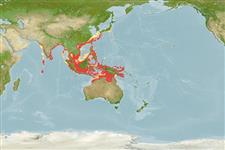
seewasser; brackwasser benthopelagisch; tiefenbereich 0 - 100 m (Ref. 6181). Tropical; 36°N - 17°S, 69°E - 154°E (Ref. 6181)
Indo-West Pacific: India and Sri Lanka to Southeast Asia, north to China, and south to New Guinea and northern Australia.
Länge bei der ersten Reifung / Größe / Gewicht / Alter
Geschlechtsreife: Lm 38.0 range ? - ? cm
Max length : 100.0 cm SL Männchen/unbestimmt; (Ref. 6042); common length : 70.0 cm SL Männchen/unbestimmt; (Ref. 6042)
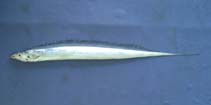
Rückenflossenstacheln (insgesamt) : 3 - 4; Rückenflossenweichstrahlen (insgesamt) : 110 - 120. Pelvic and caudal fins absent; anal fin reduced to spinules (about 75). Lateral line running nearer the ventral than the dorsal contour of the body. Color is steely blue with metallic reflections; the tapering part white. The margin of the anus pale; usually the margin of the caudal-fin membrane white; tip of both jaws black; the inside of the opercle and the anterior part of the shoulder girdle, pale black.
Body shape (shape guide): elongated; Cross section: compressed.
Inhabits coastal waters and often comes near the surface at night. Feeds on a variety of small fishes and crustaceans (chiefly on prawns and species of Setippina, Anchoviella, Harpodon, Trichiurus etc. in Hooghly estuaries in India). Caught mainly with shore seines, bagnets and coastal bottom trawls in Asian countries. Marketed fresh and iced as well as dried salted.
Nakamura, I. and N.V. Parin, 1993. FAO Species Catalogue. Vol. 15. Snake mackerels and cutlassfishes of the world (families Gempylidae and Trichiuridae). An annotated and illustrated catalogue of the snake mackerels, snoeks, escolars, gemfishes, sackfishes, domine, oilfish, cutlassfishes,. scabbardfishes, hairtails, and frostfishes known to date. FAO Fish. Synop. 125(15):136 p. (Ref. 6181)
IUCN Rote Liste Status (Ref. 130435: Version 2025-2 (Global))
Bedrohung für Menschen
Harmless
Nutzung durch Menschen
Fischereien: kommerziell
Tools
Zusatzinformationen
Download XML
Internet Quellen
Schätzungen auf der Grundlage von Modellen
Bevorzugte Temperatur (Ref.
123201): 25.3 - 29.1, mean 28.3 °C (based on 1816 cells).
Phylogenetischer Diversitätsindex (Ref.
82804): PD
50 = 0.6250 [Uniqueness, from 0.5 = low to 2.0 = high].
Bayesian length-weight: a=0.00068 (0.00047 - 0.00098), b=3.03 (2.92 - 3.14), in cm total length, based on LWR estimates for this species (Ref.
93245).
Trophische Ebene (Ref.
69278): 4.3 ±0.76 se; based on food items.
Generation time: 2.0 ( na - na) years. Estimated as median ln(3)/K based on 2
growth studies.
Widerstandsfähigkeit (Ref.
120179): hoch, Verdopplung der Population dauert weniger als 15 Monate. (K=0.7; Fec=9,178).
Anfälligkeit der Fischerei (Ref.
59153): Moderate vulnerability (36 of 100).
🛈
Nährstoffe (Ref.
124155): Calcium = 91.5 [45.4, 171.3] mg/100g; Iron = 0.944 [0.475, 1.749] mg/100g; Protein = 18 [16, 20] %; Omega3 = 0.168 [0.084, 0.377] g/100g; Selenium = 97 [45, 216] μg/100g; VitaminA = 14.8 [4.0, 45.1] μg/100g; Zinc = 0.898 [0.602, 1.445] mg/100g (wet weight);