Klassificering / Namn
Populärnamn | synonymer | Catalog of Fishes(Släkte, Arter) | ITIS | CoL | WoRMS | Cloffa
Miljö: miljö / Klimatzon / djupintervall / distributionsområde
Ekologi
marina revassocierade; djupintervall 10 - 70 m (Ref. 5222). Tropical; 33°N - 4°S, 115°W - 77°W (Ref. 5222)
Eastern Pacific: Gulf of California to Peru, including the Revillagigedo, Galapagos, Clipperton, Cocos, and Malpelo islands.
Storlek / Vikt / Ålder
Könsmognad: Lm ? range ? - ? cm
Max length : 35.6 cm TL hane/ej könsbestämd; (Ref. 5592)
Kort beskrivning
Bestämningsnycklar | Morfologi | Morfometri
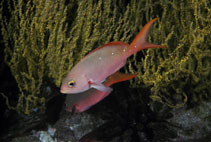
Taggstrålar i ryggfenan (totalt) : 9; Mjukstrålar i ryggfenan (totalt) : 18 - 21; Taggstrålar i analfenan: 3; Mjukstrålar i analfenan: 9 - 11. Distinguished by the following characteristics: reddish or reddish grey body color with 2-3 bright blue or violet spots on dorsal part of body and another 2 on midlateral part of caudal peduncle; pectoral-fin axil with bright blue spot; dorsal fin base darker, fin margin reddish green; depth of body contained 2.9-3.4 times in SL; head length 3.2-4.0 times in SL; convex interorbital area; subangular preopercle with shallow notch, vertical edge and rear half of lower edge finely serrate; subequal posterior and anterior nostrils (Ref. 89707).
Body shape (shape guide): fusiform / normal; Cross section: oval.
Found typically in small aggregations well above the reef, but will retreat to the reef at the approach of danger. Feeds mainly on small planktonic animals picked individually from the water, made possible by their shortened snout which facilitates close-range binocular vision. Excellent source of bait (Ref. 9342).
Livscykel och parningsbeteende
Könsmognad | Reproduktion | Lek | Ägg | Fekunditet | Larver
Heemstra, P.C. and J.E. Randall, 1993. FAO Species Catalogue. Vol. 16. Groupers of the world (family Serranidae, subfamily Epinephelinae). An annotated and illustrated catalogue of the grouper, rockcod, hind, coral grouper and lyretail species known to date. Rome: FAO. FAO Fish. Synop. 125(16):382 p. (Ref. 5222)
Status på IUCN:s rödlista (Ref. 130435: Version 2025-2 (Global))
Hot mot människor
Reports of ciguatera poisoning (Ref. 30911)
Mänskliga användningsområden
Fiskeri: husbehovsfiske; bete: usually
Verktyg
Särskilda rapporter
Ladda ner XML
Internet-källor
Uppskattningar baserade på modeller
Önskad temperatur (Ref.
123201): 18.5 - 28.9, mean 25.9 °C (based on 76 cells).
Index för fylogenetisk mångfald (Ref.
82804): PD
50 = 0.5000 [Uniqueness, from 0.5 = low to 2.0 = high].
Bayesian length-weight: a=0.01148 (0.00524 - 0.02518), b=3.04 (2.87 - 3.21), in cm total length, based on LWR estimates for this species & Genus-body shape (Ref.
93245).
Trofisk nivå (Ref.
69278): 3.8 ±0.59 se; based on food items.
Resiliens (Ref.
120179): Mellan, lägsta populationsfördubblingstid 1,4-4,4 år (Preliminary K or Fecundity.).
Sårbarhet i fisket (Ref.
59153): Low to moderate vulnerability (26 of 100).
🛈
Näringsämnen (Ref.
124155): Calcium = 43.8 [26.8, 78.1] mg/100g; Iron = 0.609 [0.338, 0.991] mg/100g; Protein = 18.3 [16.5, 19.9] %; Omega3 = 0.153 [0.102, 0.231] g/100g; Selenium = 31.5 [19.3, 56.5] μg/100g; VitaminA = 160 [59, 493] μg/100g; Zinc = 1.06 [0.74, 1.50] mg/100g (wet weight);