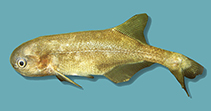
Miljö: miljö / Klimatzon / djupintervall / distributionsområde
Ekologi
; sötvatten bottenlevande; flodvandrande (Ref. 51243). Tropical; 23°C - 26°C (Ref. 2060); 3°S - 27°S
East Africa: Rovuma River system including Niassa Reserve, and western confluences to Lake Malawi (Ref. 91771). Following a recent revision of the Petrocephalus catostoma complex (Ref. 91771), unambiquous evidence for the presence of this species in the Bangweulu-Mweru area (and consequently the Congo basin) is still lacking (Ref. 91772).
Längd vid första mognad / Storlek / Vikt / Ålder
Könsmognad: Lm ?, range 4 - ? cm
Max length : 15.0 cm FL hane/ej könsbestämd; (Ref. 5214)
Taggstrålar i ryggfenan (totalt) : 0; Mjukstrålar i ryggfenan (totalt) : 18 - 22; Taggstrålar i analfenan: 0; Mjukstrålar i analfenan: 25 - 28.
Body shape (shape guide): fusiform / normal; Cross section: oval.
Occurs in shallow and muddy waters, sheltered bays, in lagoons, and swampy areas; prefers quiet parts of rivers where there is abundant vegetation (Ref. 13337). Forms shoals (Ref. 13337) within quiet reaches of rivers and floodplains, and with other species with identical electric organ discharge (EOD) waveforms (Ref. 10460). Feeds on insects, found on river bed or in marginal vegetation (Ref. 12526), on insect larvae and other invertebrates at night (Ref. 5595). Known to undergo upriver migration (Ref. 13337, 10608) which may well be correlated with breeding (Ref. 13337). Breeds during the rainy season, possibly moving upstream to suitable sites (Ref. 10608). An unconfirmed report claims the males are territorial and build a nest (Ref. 7248). Caught in nets for food (5214). Oviparous (Ref. 205).
Kramer, B., R. Bills, P. Skelton and M. Wink, 2012. A critical revision of the churchill snoutfish, genus Petrocephalus Marcusen, 1854 (Actinopterygii: Teleostei: Mormyridae), from southern and eastern Africa, with the recognition of Petrocephalus tanensis, and the description of five new species. Journal of Natural History 46(35-36):2179-2258. (Ref. 91771)
Status på IUCN:s rödlista (Ref. 130435: Version 2025-2 (Global))
Hot mot människor
Harmless
Mänskliga användningsområden
Fiskeri: husbehovsfiske; Akvarium: Kommersiell
Verktyg
Särskilda rapporter
Ladda ner XML
Internet-källor
Uppskattningar baserade på modeller
Index för fylogenetisk mångfald (Ref.
82804): PD
50 = 0.5000 [Uniqueness, from 0.5 = low to 2.0 = high].
Bayesian length-weight: a=0.01349 (0.00750 - 0.02425), b=2.82 (2.67 - 2.97), in cm total length, based on LWR estimates for this species & Genus-body shape (Ref.
93245).
Trofisk nivå (Ref.
69278): 3.4 ±0.38 se; based on food items.
Generation time: 1.4 ( na - na) years. Estimated as median ln(3)/K based on 2
growth studies.
Resiliens (Ref.
120179): Mellan, lägsta populationsfördubblingstid 1,4-4,4 år (Fec = 116).
Sårbarhet i fisket (Ref.
59153): Low vulnerability (17 of 100).
🛈