Elasmobranchii (haaien en roggen) (sharks and rays) >
Carcharhiniformes (Ground sharks) >
Scyliorhinidae (Cat sharks) > Scyliorhininae
Etymology: Scyliorhinus: skylion, Greek for dogfish or small shark; rhinus, from rhine (Gr.), rasp, alluding to a shark’s jagged, rasp-like skin (See ETYFish); capensis: -ensis, Latin suffix denoting place: Cape of Good Hope, South Africa, type locality (See ETYFish).
More on authors: Müller & Henle.
Milieu: milieu / Klimaatzone / Diepte / verspreidingsgebied
Ecologie
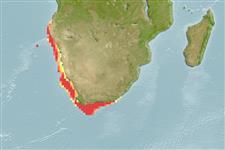
marien demersaal; diepte 26 - 495 m (Ref. 5578). Subtropical; 0°S - 37°S, 0°W - 29°E (Ref. 57015)
Southeast Atlantic: Lüderitz, Namibia to central Natal, South Africa.
Lengte bij maturiteit / Grootte / Gewicht / Leeftijd
Maturiteit: Lm 69.0, range 68 - 70 cm
Max length : 122 cm TL mannelijk / geslacht onbekend; (Ref. 244)
Korte beschrijving
Determinatiesleutels | Morfologie | Morfometrie
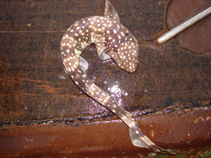
Dorsale stekels (totaal) : 0; Anale stekels: 0. Bright yellow or golden spots on a dark grey body with irregular blotches and saddles (Ref. 5578), cream below (Ref. 5510); 2nd dorsal much smaller than 1st (Ref. 5578). Small anterior nasal flaps that do not reach mouth, no nasoral grooves (Ref. 244).
Body shape (shape guide): elongated; Cross section: compressed.
A common inshore to offshore catshark. Prefers to feed on small bony fishes and crustaceans, also cephalopods (Ref. 244). Oviparous (Ref. 50449).
Oviparous, with a single egg per oviduct at a time (Ref. 244). Oviparous, paired eggs are laid. Embryos feed solely on yolk (Ref. 50449). Size upon hatching below 31 cm (size of young with umbilical scars) (Ref. 244).
Compagno, L.J.V., 1984. FAO Species Catalogue. Vol. 4. Sharks of the world. An annotated and illustrated catalogue of shark species known to date. Part 2 - Carcharhiniformes. FAO Fish. Synop. 125(4/2):251-655. Rome: FAO. (Ref. 244)
Status op de Rode Lijst van het IUCN (Ref. 130435: Version 2025-2 (Global))
Gevaar voor de mens
Harmless
Gebruik door de mens
Visserij: van geen belang; sportvis: ja
Tools
Speciale rapporten
Download XML
Internetbronnen
Schattingen op basis van modellen
Gewenste temperatuur (Ref.
123201): 9.3 - 16.5, mean 12.2 °C (based on 45 cells).
Fylogenetische diversiteitsindex (Ref.
82804): PD
50 = 0.5000 [Uniqueness, from 0.5 = low to 2.0 = high].
Bayesian length-weight: a=0.00269 (0.00140 - 0.00518), b=3.21 (3.04 - 3.38), in cm total length, based on LWR estimates for this (Sub)family-body shape (Ref.
93245).
Trofisch niveau (Ref.
69278): 4.0 ±0.5 se; based on diet studies.
Weerstandsvermogen (Ref.
120179): Zeer laag, minimale populatieverdubbelingstijd meer dan 14 jaar (Fec = 1).
Kwetsbaarheid van de visserij (Ref.
59153): High to very high vulnerability (73 of 100).
🛈