>
Gadiformes (Cods) >
Macrouridae (Grenadiers or rattails)
Etymology: Coryphaenoides: Greek, koryphaina = dolphin fish + Suffix oides = similar to (Ref. 45335).
More on author: Vaillant.
Umwelt: Milieu / Klimazone / Tiefenbereich / Verbreitungsgebiet
Ökologie
seewasser bathydemersal; standorttreu; tiefenbereich 400 - 2375 m (Ref. 3587). Deep-water; 37°N - 0°N, 98°W - 4°W (Ref. 1371)
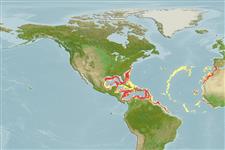
Central Atlantic: Western Central Atlantic: off Chesapeake Bay, Gulf of Mexico, and the Caribbean. Eastern Central Atlantic: Mauritania to Côte d'Ivoire.
Größe / Gewicht / Alter
Geschlechtsreife: Lm ? range ? - ? cm
Max length : 40.0 cm TL Männchen/unbestimmt; (Ref. 1371)
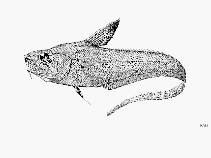
Rückenflossenstacheln (insgesamt) : 2; Afterflossenstacheln: 0. Head large, completely scaled, including the ventral surfaces of the snout; snout short, narrow, with stout scutes at its tip and lateral angles; mouth small, restricted laterally. Scales with numerous (over 100 in large specimens) short, stout spinules arranged in V-shaped rows. Pyloric caeca short, 10 to 15. Overall color is medium to dark brown; fins generally blackish.
Body shape (shape guide): elongated; Cross section: circular.
Feeds primarily on benthic organisms, especially gammarian amphipods and, to a lesser extent, lamellibranchs, copepods, polychaetes, ostracods, isopods mysids, Natantia, and echinoderms (Ref. 1371). Minimum depth record from Ref. 1371.
Lebenszyklus und Paarungsverhalten
Geschlechtsreife | Fortpflanzung | Ablaichen | Eier | Fruchtbarkeit | Larven
Cohen, D.M., T. Inada, T. Iwamoto and N. Scialabba, 1990. FAO species catalogue. Vol. 10. Gadiform fishes of the world (Order Gadiformes). An annotated and illustrated catalogue of cods, hakes, grenadiers and other gadiform fishes known to date. FAO Fish. Synop. 125(10). Rome: FAO. 442 p. (Ref. 1371)
IUCN Rote Liste Status (Ref. 130435: Version 2025-2 (Global))
Bedrohung für Menschen
Harmless
Nutzung durch Menschen
Fischereien: nicht kommerziell
Tools
Zusatzinformationen
Download XML
Internet Quellen
Schätzungen auf der Grundlage von Modellen
Bevorzugte Temperatur (Ref.
123201): 4.6 - 10, mean 6.2 °C (based on 211 cells).
Phylogenetischer Diversitätsindex (Ref.
82804): PD
50 = 0.5000 [Uniqueness, from 0.5 = low to 2.0 = high].
Bayesian length-weight: a=0.00219 (0.00111 - 0.00432), b=3.20 (3.03 - 3.37), in cm total length, based on LWR estimates for this (Sub)family-body shape (Ref.
93245).
Trophische Ebene (Ref.
69278): 3.2 ±0.37 se; based on food items.
Widerstandsfähigkeit (Ref.
120179): niedrig, Verdopplung der Population dauert 4,5 - 14 Jahre. (Preliminary K or Fecundity.).
Anfälligkeit der Fischerei (Ref.
59153): Low to moderate vulnerability (30 of 100).
🛈