Elasmobranchii (haaien en roggen) (sharks and rays) >
Carcharhiniformes (Ground sharks) >
Scyliorhinidae (Cat sharks) > Scyliorhininae
Etymology: Scyliorhinus: skylion, Greek for dogfish or small shark; rhinus, from rhine (Gr.), rasp, alluding to a shark’s jagged, rasp-like skin (See ETYFish); haeckelii: In honor of Ernst Haeckel (1834-1919), German biologist, philosopher and artist, the “formemost philosophical thinker of the day” (translation) (See ETYFish).
Eponymy: Dr Ernst Heinrich Philipp August Haeckel (1834–1919) was an evolutionary biologist, zoologist, philosopher, and artist. [...] (Ref. 128868), visit book page.
Milieu: milieu / Klimaatzone / Diepte / verspreidingsgebied
Ecologie
marien demersaal, usually 37 - 402 m (Ref. 107325). Deep-water; 11°N - 32°S
Western Atlantic: coast of Venezuela to Brazil, Amapá state (confirmation needed) and from northern Rio de Janeiro state to Argentina.
Lengte bij maturiteit / Grootte / Gewicht / Leeftijd
Maturiteit: Lm ?, range 40 - ? cm
Max length : 60.0 cm TL mannelijk / geslacht onbekend; (Ref. 57911); 50.9 cm TL (female); common length : 25.0 cm TL mannelijk / geslacht onbekend; (Ref. 5217)
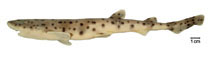
This species is distinguished by the following characters: triangular or squared tipped first dorsal fin (vs. never squared tipped in S. ugoi, S. cabofriensis); neurocranium with a narrow basal plate (vs. broad in S. cabofriensis); color pattern with saddles not delineated by light or dark spots (vs. delineated by light or dark spots in S. boa); saddles darker than background color and lacking sharp median projections (vs. saddles indistinct S. cabofriensis, S. boa, with sharp median projections in S. ugoi); spots large and small, sometimes sickle-shaped or lunate and with clear centers on the back and sides, arranged in approximate bilateral symmetry, and sometimes present in intersaddle regions (vs. spots spiracle-sized, randomly distributed, not sickle-shaped or lunate in S. cabofriensis); rounded and short snout, preoral length 4.5% TL (vs. 5% TL in S. ugoi, S. cabofriensis); short and depressed head, length 17.5-19.2% TL (vs. 19.7-20.8% in S. cabofriensis; 19.5-20.3% in S. ugoi); interdorsal space 1.2-2 times dorsal-caudal space (vs. 2 times in S. cabofriensis; 2.1-2.5 in S. ugoi); claspers with ventral terminal cartilage 2 slender and positioned above ventral terminal cartilage, length 1.8 times in ventral terminal cartilage (vs. 1.5 times in S. cabofriensis); ventral terminal cartilage without a prominent groove posteriorly or with shallow and poorly developed groove (vs. groove well developed in S. cabofriensis); small-sized, adult males at about 35.3 cm TL, adult females at about 41.5 cm TL (vs. 44.5 cm and 50.0 cm TL, respectively, in S. ugoi) (Ref. 107325).
Body shape (shape guide): elongated; Cross section: circular.
This species is reported to be associated with coral or calcareous algal formations where it possibly lays it egg-capsules. Stomach contents include squid beaks and skeletal elements of bony fishes. Reported males with well-developed claspers at about 35.3 cm TL; females as adults from 41.5 cm TL. Egg-capsules observed to have light amber to yellowish colour, without longitudinal grooves and measure about 6.0 cm in length, 2.5 cm in width (Ref. 107325). Found on the continental shelf and upper slope. Oviparous. Not utilized at present (Ref. 244).
Oviparous, paired eggs are laid. Embryos feed solely on yolk (Ref. 50449).
Compagno, L.J.V., 1984. FAO Species Catalogue. Vol. 4. Sharks of the world. An annotated and illustrated catalogue of shark species known to date. Part 2 - Carcharhiniformes. FAO Fish. Synop. 125(4/2):251-655. Rome: FAO. (Ref. 244)
Status op de Rode Lijst van het IUCN (Ref. 130435: Version 2025-2 (Global))
Gevaar voor de mens
Harmless
Gebruik door de mens
Visserij: van geen belang
Tools
Speciale rapporten
Download XML
Internetbronnen
Schattingen op basis van modellen
Gewenste temperatuur (Ref.
123201): 16.4 - 24.9, mean 18.6 °C (based on 50 cells).
Fylogenetische diversiteitsindex (Ref.
82804): PD
50 = 0.5000 [Uniqueness, from 0.5 = low to 2.0 = high].
Bayesian length-weight: a=0.00269 (0.00140 - 0.00518), b=3.21 (3.04 - 3.38), in cm total length, based on LWR estimates for this (Sub)family-body shape (Ref.
93245).
Trofisch niveau (Ref.
69278): 3.9 ±0.5 se; based on size and trophs of closest relatives
Weerstandsvermogen (Ref.
120179): Zeer laag, minimale populatieverdubbelingstijd meer dan 14 jaar (Fec = 2).
Kwetsbaarheid van de visserij (Ref.
59153): Moderate vulnerability (44 of 100).
🛈