Ambiente: milieu / zona climática / intervalo de profundidade / gama de distribuição
Ecologia
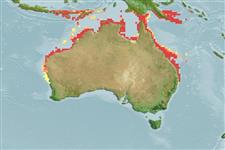
marinhas; estuarina demersal; não migratória; intervalo de profundidade 0 - 10 m (Ref. 6205). Tropical; 8°S - 30°S, 110°E - 157°E (Ref. 6205)
Western Central Pacific: northern Australia, from Shark Bay, Western Australia to Moreton Bay, Queensland. Also known from the southern coast of New Guinea. Sillago nierstraszi is almost certainly a synonym of this species.
Tamanho / Peso / Idade
Maturidade: Lm ? range ? - ? cm
Max length : 45.0 cm SL macho/indeterminado; (Ref. 6205); common length : 35.0 cm SL macho/indeterminado; (Ref. 9679)
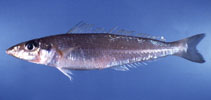
Espinhos dorsais (total) : 12; Raios dorsais moles (total) : 16 - 18; Espinhos anais: 2; Raios anais moles: 14 - 17; Vértebras: 33 - 34. The shape of the swim bladder is not distinguishable from that of S. ciliata. The anterior part of the swim bladder has rudimentary tubules projecting anteriorly and a lateral series, that diminishes in size and becoming sawtooth-like, projecting posteriorly. Body is light silvery, slightly darker to dusky dorsally. A dull golden silver to golden yellow stripe is below the lateral line. The pelvic and anal fins are pale yellow to bright yellow; the pectoral fin has a darker dusting of fine black-brown spots.
Body shape (shape guide): fusiform / normal; Cross section: circular.
Juveniles of this species, together with those of S. schomburgkii remain in warm waters of the shallow mangrove creek shorelines and protected inlets. Mature S. analis prefer the muddy, tidal streams. The preferred prey are crustaceans. They also rummage in the silty-sand substrates for worms and have been observed to 'plough' up the bottom with the snout (Ref. 6205). Oviparous (Ref. 205).
Ciclo de vida e comportamento de acasalamento
Maturidade | Reprodução | Desova | Ovos | Fecundidade | Larvas
McKay, R.J., 1992. FAO Species Catalogue. Vol. 14. Sillaginid fishes of the world (family Sillaginidae). An annotated and illustrated catalogue of the sillago, smelt or Indo-Pacific whiting species known to date. Rome: FAO. FAO Fish. Synop. 125(14):87p. (Ref. 6205)
Categoria na Lista Vermelha da IUCN (Ref. 130435: Version 2025-2 (Global))
Ameaça para o homem
Harmless
Utilização humana
Pescarias: espécies comerciais; Aquacultura: uso futuro provável
Ferramentas
Relatórios especiais
Descarregue XML
Fontes da internet
Estimativas baseadas em modelos
Temperatura preferida (Ref.
123201): 24.6 - 28.7, mean 27.8 °C (based on 560 cells).
Índice de diversidade filogenética (Ref.
82804): PD
50 = 0.5000 [Uniqueness, from 0.5 = low to 2.0 = high].
Bayesian length-weight: a=0.00851 (0.00363 - 0.01997), b=3.08 (2.87 - 3.29), in cm total length, based on LWR estimates for this (Sub)family-body shape (Ref.
93245).
Nível Trófico (Ref.
69278): 3.3 ±0.1 se; based on diet studies.
Generation time: 2.2 ( na - na) years. Estimated as median ln(3)/K based on 1
growth studies.
Resiliência (Ref.
120179): Elevada, tempo mínimo de duplicação da população menor que 15 meses (Preliminary K or Fecundity.).
Vulnerabilidade da pesca (Ref.
59153): Low to moderate vulnerability (28 of 100).
🛈