Elasmobranquios (tiburones y rayas) (sharks and rays) >
Carcharhiniformes (Ground sharks) >
Scyliorhinidae (Cat sharks) > Scyliorhininae
Etymology: Scyliorhinus: skylion, Greek for dogfish or small shark; rhinus, from rhine (Gr.), rasp, alluding to a shark’s jagged, rasp-like skin (See ETYFish); retifer: rete, diminutive of reticulum (L.), net; -fer, from fero (L.), to have or bear, referring to its mesh- or chain-like pattern (See ETYFish).
More on author: Garman.
Entorno: milieu / zona climática / rango de profundidad / gama de distribución
Ecología
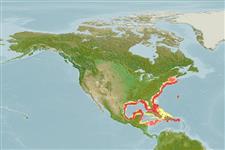
marino demersal; rango de profundidad 36 - 750 m (Ref. 26938). Subtropical; 45°N - 15°N, 99°W - 64°W (Ref. 55294)
Western Atlantic: southern New England to Florida in the USA and northern Gulf of Mexico to Nicaragua. Atlantic coast from Cape Cod to Florida, and west Caribbean from Yucatan to Nicaragua (Ref. 26938).
Tamaño / Peso / Edad
Madurez: Lm ? range ? - ? cm
Max length : 48.0 cm TL macho / no sexado; (Ref. 26938); 47.0 cm TL (female)
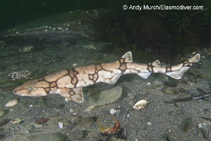
Body small and slender; boldly marked body with a pattern of distinct black lines on a pale brownish background. Origin of the first dorsal fin behind free rear tip of pelvic fin (Ref. 26938).
Body shape (shape guide): elongated.
Found on the outer continental shelf and upper slope on rough, rocky bottom. Water temperature: 8.5-11.3°C. Food habits unknown. Oviparous. Not utilized at present. Found in waters 75-550 m deep (Ref. 26938). Lives at depths off 36-230m in the northern portion of its range, and in waters deeper than 460m in its southern range (Ref. 55294). Maximum depth reported taken from Ref. 55584.
Ciclo vital y comportamiento de apareamiento
Madurez | Reproducción | Puesta | Huevos | Fecundidad | Larva
Oviparous, paired eggs are laid. Embryos feed solely on yolk (Ref. 50449). During courtship and prior to copulation, the male bites and wraps female pectoral fin body, tail and gills (Ref. 49562, 51128).
Compagno, L.J.V., 1984. FAO Species Catalogue. Vol. 4. Sharks of the world. An annotated and illustrated catalogue of shark species known to date. Part 2 - Carcharhiniformes. FAO Fish. Synop. 125(4/2):251-655. Rome: FAO. (Ref. 244)
Situación en la Lista Roja de la UICN (Ref. 130435: Version 2025-2 (Global))
Amenaza para el ser humano
Harmless
Usos humanos
Pesquerías: sin interés
Herramientas
Informes especiales
Descargar XML
Fuentes de Internet
Estimaciones basadas en modelos
Temperatura preferida (Referencia
123201): 11.4 - 22.7, mean 16.8 °C (based on 93 cells).
Índice de diversidad filogenética (Referencia
82804): PD
50 = 0.5000 [Uniqueness, from 0.5 = low to 2.0 = high].
Bayesian length-weight: a=0.00224 (0.00145 - 0.00346), b=3.16 (3.03 - 3.29), in cm total length, based on LWR estimates for this species & (Sub)family-body (Ref.
93245).
Nivel trófico (Referencia
69278): 4.4 ±0.3 se; based on diet studies.
Resiliencia (Referencia
120179): Bajo, población duplicada en un tiempo mínimo de 4.5-14 años (Fec assumed to be <100).
Vulnerabilidad pesquera (Ref.
59153): Moderate vulnerability (38 of 100).
🛈