>
Scombriformes (Mackerels) >
Trichiuridae (Cutlassfishes) > Aphanopodinae
Etymology: Benthodesmus: Greek, benthos = depth of the sea + Greek, desmos = bond, chain (Ref. 45335); simonyi: Named after Prof. Oskar Simony of Mathematics and Physics, Hochschule für Bodenkultur, Vienna, eclectic and collector (Ref. 6885).
Eponymy: Dr Oskar Simony (1852–1915) was an Austrian mathematician, physicist and naturalist. [...] (Ref. 128868), visit book page.
More on author: Steindachner.
Umwelt: Milieu / Klimazone / Tiefenbereich / Verbreitungsgebiet
Ökologie
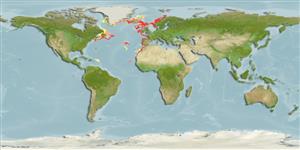
seewasser benthopelagisch; tiefenbereich 200 - 900 m (Ref. 6181). Deep-water; 72°N - 16°N, 67°W - 20°E (Ref. 6181)
North Atlantic: off Newfoundland (Canada), Bermuda, New England (USA), Middle Atlantic Ridges, Iceland, Norway, Portugal, Madeira, and Canary Islands.
Größe / Gewicht / Alter
Geschlechtsreife: Lm ? range ? - ? cm
Max length : 130 cm SL Männchen/unbestimmt; (Ref. 6181)
Rückenflossenstacheln (insgesamt) : 44 - 46; Rückenflossenweichstrahlen (insgesamt) : 104 - 109; Afterflossenstacheln: 2; Afterflossenweichstrahlen: 93 - 102; Wirbelzahl: 153 - 158. Body silvery, jaws and opercle blackish. The inside of the mouth and gill cavities black.
Body shape (shape guide): eel-like; Cross section: compressed.
Found on continental slope and underwater rises. Juveniles mesopelagic.
Lebenszyklus und Paarungsverhalten
Geschlechtsreife | Fortpflanzung | Ablaichen | Eier | Fruchtbarkeit | Larven
Nakamura, I. and N.V. Parin, 1993. FAO Species Catalogue. Vol. 15. Snake mackerels and cutlassfishes of the world (families Gempylidae and Trichiuridae). An annotated and illustrated catalogue of the snake mackerels, snoeks, escolars, gemfishes, sackfishes, domine, oilfish, cutlassfishes,. scabbardfishes, hairtails, and frostfishes known to date. FAO Fish. Synop. 125(15):136 p. (Ref. 6181)
IUCN Rote Liste Status (Ref. 130435: Version 2025-2 (Global))
Bedrohung für Menschen
Harmless
Nutzung durch Menschen
Tools
Zusatzinformationen
Download XML
Internet Quellen
Schätzungen auf der Grundlage von Modellen
Bevorzugte Temperatur (Ref.
123201): 6.4 - 11.4, mean 9.8 °C (based on 59 cells).
Phylogenetischer Diversitätsindex (Ref.
82804): PD
50 = 0.5005 [Uniqueness, from 0.5 = low to 2.0 = high].
Bayesian length-weight: a=0.00011 (0.00006 - 0.00022), b=3.06 (2.88 - 3.24), in cm total length, based on LWR estimates for this species & (Sub)family-body (Ref.
93245).
Trophische Ebene (Ref.
69278): 4.3 ±0.7 se; based on size and trophs of closest relatives
Widerstandsfähigkeit (Ref.
120179): niedrig, Verdopplung der Population dauert 4,5 - 14 Jahre. (Assuming tmax>10).
Anfälligkeit der Fischerei (Ref.
59153): Very high vulnerability (90 of 100).
🛈
Nährstoffe (Ref.
124155): Calcium = 14.1 [6.2, 28.2] mg/100g; Iron = 0.268 [0.123, 0.592] mg/100g; Protein = 17.2 [15.5, 18.8] %; Omega3 = 0.246 [0.110, 0.576] g/100g; Selenium = 30.8 [11.5, 79.2] μg/100g; VitaminA = 7 [1, 37] μg/100g; Zinc = 0.311 [0.195, 0.528] mg/100g (wet weight);