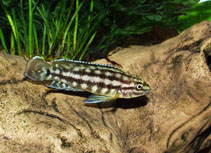
>
Cichliformes (Cichlids, convict blennies) >
Cichlidae (Cichlids) > Pseudocrenilabrinae
Etymology: Julidochromis: Taken from marine wrasse "julidini"; also from Greek, ioulis = a fish dealing with genera Coris or Thalassoma (Ref. 45335).
Eponymy: Dr Georges Marlier was a Belgian entomologist and zoologist whose doctorate was awarded by the University of Brussels. [...] (Ref. 128868), visit book page.
More on author: Poll.
Umwelt: Milieu / Klimazone / Tiefenbereich / Verbreitungsgebiet
Ökologie
; süßwasser demersal; pH range: 7.5 - 9.0; dH range: ? - 12, usually 3 - 9 m (Ref. 54894). Tropical; 22°C - 25°C (Ref. 1672); 3°S - 6°S, 30°E -
Africa: Endemic to the northwestern part of Lake Tanganyika.
Größe / Gewicht / Alter
Geschlechtsreife: Lm ? range ? - ? cm
Max length : 13.0 cm TL Männchen/unbestimmt; (Ref. 5651)
These fish are hardy, peaceful toward other species and highly intelligent. They are microfeeders and not carnivorous. In the wild, they often stay in deep water and never come to the surface to feed. They never swim in midwater but are typical rock-dwellers. Ventures into the open but never far from the rock cover. Breeds in crevices and caves (Ref. 6770). Monogamous pairs are most common (Ref. 54944).
Lebenszyklus und Paarungsverhalten
Geschlechtsreife | Fortpflanzung | Ablaichen | Eier | Fruchtbarkeit | Larven
The same study (Ref. 54894) claims that polyandry aside from monogamy is also demonstrated by this species because of some observations in the nesting area where a female occupies 2 territories each with a male. This idea of an expanded mating system for J. marlieri was initially suggested by Yamagishi and Kohda (1996). However, monogamous pairs are most common (Ref. 54944). Males guard the nest against attacks by cichlid and non-cichlid predators alike (Ref. 54944).
Maréchal, C. and M. Poll, 1991. Julidochromis. p. 202-205. In J. Daget, J.-P. Gosse, G.G. Teugels and D.F.E. Thys van Audenaerde (eds.) Check-list of the freshwater fishes of Africa (CLOFFA). ISNB, Brussels; MRAC, Tervuren; and ORSTOM, Paris. Vol. 4. (Ref. 5651)
IUCN Rote Liste Status (Ref. 130435: Version 2025-2 (Global))
Bedrohung für Menschen
Harmless
Nutzung durch Menschen
Fischereien: kommerziell; Aquarium: Kommerziell
Tools
Zusatzinformationen
Download XML
Internet Quellen
Schätzungen auf der Grundlage von Modellen
Phylogenetischer Diversitätsindex (Ref.
82804): PD
50 = 0.5156 [Uniqueness, from 0.5 = low to 2.0 = high].
Bayesian length-weight: a=0.00389 (0.00180 - 0.00842), b=3.12 (2.94 - 3.30), in cm total length, based on all LWR estimates for this body shape (Ref.
93245).
Trophische Ebene (Ref.
69278): 2.5 ±0.00 se; based on food items.
Widerstandsfähigkeit (Ref.
120179): mittel, Verdopplung der Population dauert 1,4 - 4,4 Jahre. (Fec = 70).
Anfälligkeit der Fischerei (Ref.
59153): Low vulnerability (10 of 100).
🛈