Elasmobranchi (squali e razze) (sharks and rays) >
Carcharhiniformes (Ground sharks) >
Carcharhinidae (Requiem sharks)
Etymology: Carcharhinus: karcharos (Gr.), sharp or jagged; rhinus, an ancient name for sharks, from rhine (Gr.), rasp, both words alluding to a shark's jagged, rasp-like skin (See ETYFish); amblyrhynchos: amblys (Gr.), blunt; rhynchos (Gr.), snout, referring to its long, broadly rounded snout (See ETYFish).
More on author: Bleeker.
Ambiente: milieu / zona climatica / distribuzione batimetrica / gamma di distribuzione
Ecologia
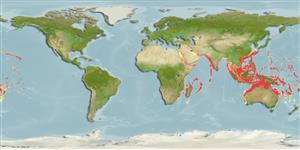
marino associati a barriera corallina; oceanodromo (Ref. 51243); distribuzione batimetrica 0 - 1000 m (Ref. 55178), usually 0 - 280 m (Ref. 6871). Tropical; 29°N - 35°S, 33°E - 151°W (Ref. 55178)
Indo-West Pacific to Central Pacific: Madagascar and the Mauritius-Seychelles area to Tuamoto Archipelago; north to southern China; south to northern Australia.
Lunghezza alla prima maturità / Dimensione / Peso / Età
Maturità: Lm 128.0, range 96 - 142 cm
Max length : 255 cm TL maschio/sesso non determinato; (Ref. 2334); 172.0 cm TL (female); peso massimo pubblicato: 33.7 kg (Ref. 4699); Età massima riportata: 25 anni (Ref. 37816)
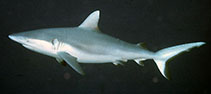
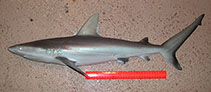
Spine dorsali (totale) : 0; Spine anali: 0. Dark grey or bronze-grey above, white below; caudal fin with a conspicuous wide black posterior margin; undersides of pectoral and pelvic fins with black tips and posterior margins, but fins otherwise not conspicuously black or white-tipped except for white-tipped first dorsal in some individuals (Ref. 9997).
Body shape (shape guide): fusiform / normal.
Occurs on continental and insular shelves and oceanic waters adjacent to them (Ref. 244). Common on coral reefs, often in deeper areas near drop-offs to the open sea, in atoll passes, and in shallow lagoons adjacent to areas of strong currents (Ref. 244). Coastal-pelagic near the bottom, near drop-offs at 1-275 m (Ref. 58302). Forms daytime schools or aggregations in favored areas (Ref. 244). Although active during the day, it is more active nocturnally (Ref. 244). Viviparous, with 1-6 pups (Ref. 37816). Feeds on reef fishes, squids, octopi, crabs, lobsters and shrimps (Ref. 244, 5578). Tends to be aggressive under baited conditions (Ref. 6871) and readily enters into a frenzy feeding pattern, at which time it may become quite dangerous. Repeatedly incriminated in human attacks. Utilized for human consumption, fishmeal, and other shark products. Minimum depth from Ref. 6871. Maximum length of female taken from Ref. 5213.
Viviparous, placental (Ref. 50449). 1-6 pups in a litter (Ref. 244). Gestation period about 12 months (Ref. 244). Size at birth 50 to 60 cm (Ref. 26346, 37816) or 75 cm (Ref. 244). Distinct pairing with embrace (Ref. 205).
Compagno, L.J.V., 1984. FAO Species Catalogue. Vol. 4. Sharks of the world. An annotated and illustrated catalogue of shark species known to date. Part 2 - Carcharhiniformes. FAO Fish. Synop. 125(4/2):251-655. Rome: FAO. (Ref. 244)
Stato della Lista Rossa IUCN (Ref. 130435: Version 2025-2 (Global))
Minaccia per l'uomo
Traumatogenic (Ref. 4716)
Usi umani
Pesca: scarso interesse commerciale; Pesce da pesca sportiva: si
Strumenti
Rapporti speciali
Scarica XML
Fonti Internet
Stime basate su modelli
Temperatura preferita (Fonte Biblio.
123201): 17.5 - 29, mean 27.5 °C (based on 4022 cells).
Indice di diversità filogenetica (Fonte Biblio.
82804): PD
50 = 0.5000 [Uniqueness, from 0.5 = low to 2.0 = high].
Bayesian length-weight: a=0.00537 (0.00322 - 0.00894), b=3.12 (2.98 - 3.26), in cm total length, based on LWR estimates for this species & Genus-body shape (Ref.
93245).
Livello trofico (Fonte Biblio.
69278): 4.1 ±0.5 se; based on diet studies.
Resilienza (Fonte Biblio.
120179): Molto basso, tempo minimo di raddoppiamento della popolazione più di 14 anni (tm=7; tmax=25; K=0.05-0.86; Fec=1-6).
Vulnerabilità della pesca (Ref.
59153): Very high vulnerability (85 of 100).
🛈
Nutrienti (Ref.
124155): Calcium = 5.22 [1.08, 26.72] mg/100g; Iron = 0.37 [0.09, 1.07] mg/100g; Protein = 22 [19, 24] %; Omega3 = 0.123 [0.051, 0.293] g/100g; Selenium = 56.3 [15.3, 156.2] μg/100g; VitaminA = 40.1 [15.4, 109.4] μg/100g; Zinc = 0.496 [0.237, 0.971] mg/100g (wet weight);