Elasmobranchi (squali e razze) (sharks and rays) >
Carcharhiniformes (Ground sharks) >
Carcharhinidae (Requiem sharks)
Etymology: Carcharhinus: karcharos (Gr.), sharp or jagged; rhinus, an ancient name for sharks, from rhine (Gr.), rasp, both words alluding to a shark's jagged, rasp-like skin (See ETYFish); amboinensis: -ensis, Latin suffix denoting place: Ambon Island, Moluccas Islands, Indonesia, type locality (See ETYFish).
More on authors: Müller & Henle.
Ambiente: milieu / zona climatica / distribuzione batimetrica / gamma di distribuzione
Ecologia
marino; salmastro associati a barriera corallina; distribuzione batimetrica 0 - 150 m (Ref. 9997). Tropical; 26°N - 26°S
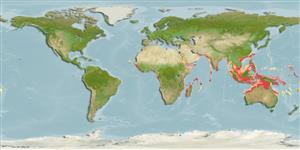
Eastern Atlantic: Nigeria. Indo-West Pacific: Persian Gulf (Ref. 68964), Gulf of Aden, South Africa, Madagascar, Pakistan, Sri Lanka, Indonesia, Papua New Guinea (Ref. 6871), and Australia. Also reported from the Mediterranean (Ref. 83386). Often confused with sympatric Carcharhinus leucas and Glyphis gangeticus but the three are distinguishable.
Lunghezza alla prima maturità / Dimensione / Peso / Età
Maturità: Lm 212.0, range 198 - 223 cm
Max length : 280 cm TL maschio/sesso non determinato; (Ref. 2334)
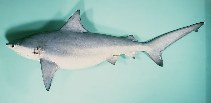
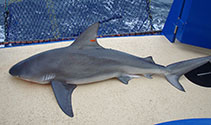
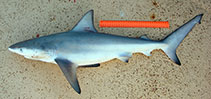
Spine dorsali (totale) : 0; Spine anali: 0. A massive shark with a thick-set head, a short, broad and blunt snout, small eyes and large, triangular, saw-edged upper teeth; 1st dorsal fin high and erect, at leas 3.2 times height of 2nd dorsal fin; no interdorsal ridge (Ref. 5578). Grayish in color, white below; fins with dusky tips (Ref. 5578).
Body shape (shape guide): fusiform / normal.
An inshore species of the continental and insular shelves, commonly inhabiting shallow waters close inshore, near the surf line and along beaches (Ref. 244). It also occasionally enters brackish water (Ref. 127434), and may be found in shallow bays and estuaries, as well as off the open coast but not ascending rivers (Ref. 9997). Predominantly demersal but found throughout the water column (Ref. 6871). Feeds on pelagic and demersal bony fishes, sharks and rays, squid, shrimps, cuttlefish, octopi, lobsters, gastropods and mammalian carrion (Ref. 5578, 9997). Viviparous (Ref. 50449). Potentially dangerous but not recorded in shark attacks to date (Ref. 9997). Utilized fresh and dried-salted for human consumption (Ref. 9997).
Viviparous, placental (Ref. 50449), with 3 to 13 in a litter (Ref. 9997). Size at birth about 43 to 53 cm TL (Ref. 9997); 60-70 cm TL (Ref.58048). Distinct pairing with embrace (Ref. 205).
Compagno, L.J.V., 1984. FAO Species Catalogue. Vol. 4. Sharks of the world. An annotated and illustrated catalogue of shark species known to date. Part 2 - Carcharhiniformes. FAO Fish. Synop. 125(4/2):251-655. Rome: FAO. (Ref. 244)
Stato della Lista Rossa IUCN (Ref. 130435: Version 2025-2 (Global))
Minaccia per l'uomo
Traumatogenic
Usi umani
Pesca: scarso interesse commerciale; Pesce da pesca sportiva: si
Strumenti
Rapporti speciali
Scarica XML
Fonti Internet
Stime basate su modelli
Temperatura preferita (Fonte Biblio.
123201): 24.5 - 28.9, mean 27.7 °C (based on 1396 cells).
Indice di diversità filogenetica (Fonte Biblio.
82804): PD
50 = 0.5000 [Uniqueness, from 0.5 = low to 2.0 = high].
Bayesian length-weight: a=0.00525 (0.00244 - 0.01130), b=3.07 (2.90 - 3.24), in cm total length, based on LWR estimates for this Genus-body shape (Ref.
93245).
Livello trofico (Fonte Biblio.
69278): 4.3 ±0.5 se; based on diet studies.
Resilienza (Fonte Biblio.
120179): Molto basso, tempo minimo di raddoppiamento della popolazione più di 14 anni (Fec=3).
Vulnerabilità della pesca (Ref.
59153): Very high vulnerability (90 of 100).
🛈
Nutrienti (Ref.
124155): Calcium = 5.19 [1.04, 27.63] mg/100g; Iron = 0.349 [0.083, 1.002] mg/100g; Protein = 22.4 [19.6, 24.7] %; Omega3 = 0.111 [0.044, 0.268] g/100g; Selenium = 36.6 [10.3, 98.5] μg/100g; VitaminA = 41.8 [13.7, 134.3] μg/100g; Zinc = 0.591 [0.280, 1.153] mg/100g (wet weight);