Elasmobranchii (hajar och rockor) (sharks and rays) >
Carcharhiniformes (Ground sharks) >
Carcharhinidae (Requiem sharks)
Etymology: Carcharhinus: karcharos (Gr.), sharp or jagged; rhinus, an ancient name for sharks, from rhine (Gr.), rasp, both words alluding to a shark's jagged, rasp-like skin (See ETYFish); brevipinna: brevis (L.), short; pinna (L.) fin, referring to small pectoral and first dorsal fins (See ETYFish).
Miljö: miljö / Klimatzon / djupintervall / distributionsområde
Ekologi
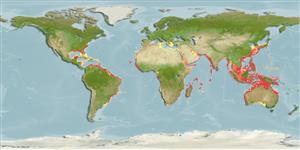
marina revassocierade; havsvandrande (Ref. 51243); djupintervall 0 - 100 m (Ref. 27000), usually 0 - ? m (Ref. 55179). Subtropical; 40°N - 38°S, 100°W - 155°E (Ref. 55179)
Atlantic, Mediterranean and Indo-West Pacific, warm temperate and tropical (Ref. 58085). Often referred to as Carcharhinus limbatus in the past.
Längd vid första mognad / Storlek / Vikt / Ålder
Könsmognad: Lm 205.8, range 170 - 266 cm
Max length : 309 cm TL hane/ej könsbestämd; (Ref. 130455); common length : 250 cm TL hane/ej könsbestämd; (Ref. 30573); publicerad maxvikt: 193.0 kg (Ref. 130455); rapporterad maxålder: 16 år (Ref. 127272)
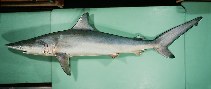
Taggstrålar i ryggfenan (totalt) : 0; Taggstrålar i analfenan: 0. A slender shark with a long, narrow, pointed snout, long gill slits and small, narrow-cusped teeth; first dorsal fin small; no interdorsal ridge; labial furrows longer than in any other grey shark (Ref. 5578). Grey above, white below, with a conspicuous white band on sides; second dorsal, anal, undersides of pectorals and lower caudal-fin lobe black or dark grey-tipped in subadults and adults, but unmarked or nearly so in small individuals (Ref. 9997).
Body shape (shape guide): fusiform / normal.
Found on the continental and insular shelves from close inshore to offshore (Ref. 244). Makes vertical spinning leaps out of the water as a feeding technique in which the sharks spins through a school of small fish with an open mouth and then breaks the surface (Ref. 9997). Feeds mainly on pelagic bony fishes, also small sharks, cuttlefish, squids, and octopi (Ref. 244, 5578). Viviparous (Ref. 50449). Forms schools (Ref. 244). Highly migratory off Florida and Louisiana and in the Gulf of Mexico (Ref. 244). Regularly caught in fisheries where found (Ref. 244). Utilized fresh and dried salted for human consumption (Ref. 244). Fins probably used in the oriental shark fin trade, and livers for vitamin oil production (Ref. 9997).
Viviparous, with a yolk-sac placenta; bears up to 20 young (Ref. 5578); 3-15 pups (Ref.58048). Size at birth 60 to 80 cm (Ref. 6871). Distinct pairing with embrace (Ref. 205).
Compagno, L.J.V., 1984. FAO Species Catalogue. Vol. 4. Sharks of the world. An annotated and illustrated catalogue of shark species known to date. Part 2 - Carcharhiniformes. FAO Fish. Synop. 125(4/2):251-655. Rome: FAO. (Ref. 244)
Status på IUCN:s rödlista (Ref. 130435: Version 2025-2 (Global))
Mänskliga användningsområden
Fiskeri: kommersiell; sportfisk: ja
Verktyg
Särskilda rapporter
Ladda ner XML
Internet-källor
Uppskattningar baserade på modeller
Önskad temperatur (Ref.
123201): 22 - 29, mean 27.4 °C (based on 3950 cells).
Index för fylogenetisk mångfald (Ref.
82804): PD
50 = 0.5000 [Uniqueness, from 0.5 = low to 2.0 = high].
Bayesian length-weight: a=0.00447 (0.00364 - 0.00548), b=3.06 (3.02 - 3.10), in cm total length, based on LWR estimates for this species (Ref.
93245).
Trofisk nivå (Ref.
69278): 4.2 ±0.6 se; based on diet studies.
Generation time: 5.2 ( na - na) years. Estimated as median ln(3)/K based on 2
growth studies.
Resiliens (Ref.
120179): Mycket låg, lägsta populationsfördubblingstid mer än 14 år (Fec=3).
Sårbarhet i fisket (Ref.
59153): High vulnerability (62 of 100).
🛈
Näringsämnen (Ref.
124155): Calcium = 3.98 [0.74, 21.53] mg/100g; Iron = 0.386 [0.096, 1.168] mg/100g; Protein = 23.1 [20.3, 25.3] %; Omega3 = 0.154 [0.058, 0.388] g/100g; Selenium = 16.9 [4.9, 52.4] μg/100g; VitaminA = 21.3 [7.3, 64.7] μg/100g; Zinc = 0.319 [0.150, 0.630] mg/100g (wet weight);