>
Scombriformes (Mackerels) >
Trichiuridae (Cutlassfishes) > Lepidopodinae
Etymology: Lepidopus: Greek, lepis = scale + Greek, pous = foot (Ref. 45335).
Umwelt: Milieu / Klimazone / Tiefenbereich / Verbreitungsgebiet
Ökologie
seewasser benthopelagisch; tiefenbereich 270 - 350 m (Ref. 6181). Deep-water; 34°N - 24°N, 178°E - 174°W (Ref. 6181)
Northwest Pacific: known only from type locality at Colahan Seamount of Hawaiian Submarine Ridge (31°01'N, 175°53'W).
Größe / Gewicht / Alter
Geschlechtsreife: Lm ? range ? - ? cm
Max length : 79.0 cm SL Männchen/unbestimmt; (Ref. 6181)
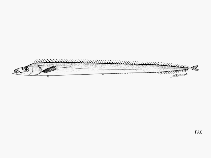
Rückenflossenweichstrahlen (insgesamt) : 91 - 93; Afterflossenstacheln: 2; Afterflossenweichstrahlen: 44 - 47; Wirbelzahl: 98 - 100. Second anal fin spine stout and spur-like. Body dark brown, becoming lighter ventrally; the opercle black, inside of the mouth and gill cavities black.
Body shape (shape guide): elongated; Cross section: compressed.
Maximum standard length recorded only from 3 specimens.
Lebenszyklus und Paarungsverhalten
Geschlechtsreife | Fortpflanzung | Ablaichen | Eier | Fruchtbarkeit | Larven
Nakamura, I. and N.V. Parin, 1993. FAO Species Catalogue. Vol. 15. Snake mackerels and cutlassfishes of the world (families Gempylidae and Trichiuridae). An annotated and illustrated catalogue of the snake mackerels, snoeks, escolars, gemfishes, sackfishes, domine, oilfish, cutlassfishes,. scabbardfishes, hairtails, and frostfishes known to date. FAO Fish. Synop. 125(15):136 p. (Ref. 6181)
IUCN Rote Liste Status (Ref. 130435: Version 2025-2 (Global))
Bedrohung für Menschen
Harmless
Nutzung durch Menschen
Tools
Zusatzinformationen
Download XML
Internet Quellen
Schätzungen auf der Grundlage von Modellen
Phylogenetischer Diversitätsindex (Ref.
82804): PD
50 = 0.5156 [Uniqueness, from 0.5 = low to 2.0 = high].
Bayesian length-weight: a=0.00275 (0.00104 - 0.00730), b=3.06 (2.83 - 3.29), in cm total length, based on LWR estimates for this (Sub)family-body shape (Ref.
93245).
Trophische Ebene (Ref.
69278): 3.8 ±0.4 se; based on size and trophs of closest relatives
Widerstandsfähigkeit (Ref.
120179): niedrig, Verdopplung der Population dauert 4,5 - 14 Jahre. (Assuming tmax>10).
Anfälligkeit der Fischerei (Ref.
59153): High vulnerability (59 of 100).
🛈