>
Siluriformes (Catfishes) >
Siluridae (Sheatfishes)
Etymology: Silurus: Greek, silouros = a cat fish + Greek, odous = teeth (Ref. 45335).
Ambiente: milieu / zona climática / intervalo de profundidade / gama de distribuição
Ecologia
; Água doce demersal. Temperate
Asia: Endemic to Lake Biwa, Japan.
Tamanho / Peso / Idade
Maturidade: Lm ? range ? - ? cm
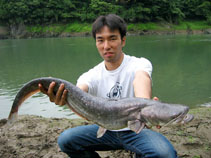
Max length : 118 cm TL macho/indeterminado; (Ref. 40637); peso máx. Publicado: 17.2 kg (Ref. 40637)
Largest species among the Japanese silurid fishes (Ref. 37518).
Ciclo de vida e comportamento de acasalamento
Maturidade | Reprodução | Desova | Ovos | Fecundidade | Larvas
Based on observations, a female first searches for a spawning site, with a male following behind. Immediately the female stops, the male first places his head under that of the female and then, by bending his body towards her anal fin, positions himself such that his tail is towards the end of the female's snout. From this position, the male then begins to wrap his tail around the head of the female, gradually winding his body tighter and moving along the body of the female until positioned at the center of her body. The male then winds his body tightly around the dorsal side of the female's abdomen for 20-30 seconds. The female then shakes her head from side to side several times, and orientates her body downward. This behavior causes the male to become separated from the female. Immediately after separation, the female releases a large number of eggs, and circles around with the male following on the inside. Although gamete release by the male was not actually observed, it seems likely that the eggs are fertilized during circling. After circling, the pair turns round twice violently, causing the eggs to become widely scattered. The pair then swim away with the female in the lead.
Kobayakawa, M., 1989. Systematic revision of the catfish genus Silurus, with description of a new species from Thailand and Burma. Jap. J. Ichthyol. 36(2):155-186. (Ref. 9417)
Categoria na Lista Vermelha da IUCN (Ref. 130435: Version 2025-2 (Global))
Ameaça para o homem
Harmless
Utilização humana
Peixe desportivo: sim
Ferramentas
Relatórios especiais
Descarregue XML
Fontes da internet
Estimativas baseadas em modelos
Índice de diversidade filogenética (Ref.
82804): PD
50 = 0.5001 [Uniqueness, from 0.5 = low to 2.0 = high].
Bayesian length-weight: a=0.00562 (0.00281 - 0.01127), b=3.00 (2.83 - 3.17), in cm total length, based on LWR estimates for this (Sub)family-body shape (Ref.
93245).
Nível Trófico (Ref.
69278): 4.2 ±0.8 se; based on size and trophs of closest relatives
Resiliência (Ref.
120179): Muito baixo, tempo mínimo de duplicação da população maior que 14 anos (Preliminary K or Fecundity.).
Vulnerabilidade da pesca (Ref.
59153): High to very high vulnerability (71 of 100).
🛈