Ambiente: milieu / zona climatica / distribuzione batimetrica / gamma di distribuzione
Ecologia
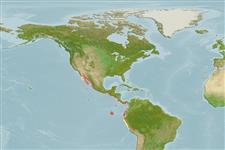
marino demersale; non migratori; distribuzione batimetrica 1 - 50 m (Ref. 89707). Tropical; 32°N - 13°S, 115°W - 76°W (Ref. 5222)
Eastern Pacific: northern Gulf of California to Peru, including the Galapagos Islands.
Dimensione / Peso / Età
Maturità: Lm ? range ? - ? cm
Max length : 30.0 cm TL maschio/sesso non determinato; (Ref. 5222); common length : 18.0 cm TL maschio/sesso non determinato; (Ref. 55763)
Breve descrizione
Chiavi di identificazione | Morfologia | Morfometria
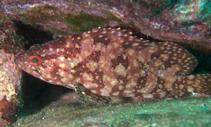
Spine dorsali (totale) : 11; Raggi dorsali molli (totale) : 17 - 19; Spine anali: 3; Raggi anali molli: 9. Preopercle rounded, the posterior edge distinctly serrate, with a large spine (usually covered with skin) projecting downward and forward at the angle. Color in life: head and body marbled reddish brown, with obscure bars and small dark and pale spots all over the head, body and median fins. Pectoral fins with 7 or 8 irregular transverse series of small dark spots (Ref. 5222); further characterized by having body depth less than or equal to head length, depth contained 2.3-2.8 times in standard length; caudal peduncle depth 11-12% of SL; eye diameter subequal to snout length, contained 4.1-5.5 times in HL; color in market: similar to color in life but color may fade to a buff, reticulations on pectoral fins usually remain (Ref. 89707).
Body shape (shape guide): fusiform / normal; Cross section: oval.
A shallow water, cryptically colored, secretive species that inhabits seagrass areas. Also found in rocky reefs in depths of 1-50 m (Ref. 89707). Sedentary during the day, hiding in crevices or lying among seaweed, and rely on their effective camouflage to escape detection. Sometimes partly covering itself with sand. Nocturnal predators feeding mainly on benthic crustaceans.
Ciclo vitale e comportamento di accoppiamento
Maturità | Riproduzione | Deposizione | Uova | Fecondità | Larve
Heemstra, P.C. and J.E. Randall, 1993. FAO Species Catalogue. Vol. 16. Groupers of the world (family Serranidae, subfamily Epinephelinae). An annotated and illustrated catalogue of the grouper, rockcod, hind, coral grouper and lyretail species known to date. Rome: FAO. FAO Fish. Synop. 125(16):382 p. (Ref. 5222)
Stato della Lista Rossa IUCN (Ref. 130435: Version 2025-2 (Global))
Minaccia per l'uomo
Harmless
Usi umani
Pesca: di nessun interesse
Strumenti
Rapporti speciali
Scarica XML
Fonti Internet
Stime basate su modelli
Temperatura preferita (Fonte Biblio.
123201): 20.6 - 28.4, mean 25.9 °C (based on 66 cells).
Indice di diversità filogenetica (Fonte Biblio.
82804): PD
50 = 0.6250 [Uniqueness, from 0.5 = low to 2.0 = high].
Bayesian length-weight: a=0.01122 (0.00550 - 0.02289), b=3.04 (2.88 - 3.20), in cm total length, based on LWR estimates for this (Sub)family-body shape (Ref.
93245).
Livello trofico (Fonte Biblio.
69278): 3.5 ±0.50 se; based on food items.
Resilienza (Fonte Biblio.
120179): Alto, tempo minimo di raddoppiamento della popolazione meno di 15 mesi (Assuming Fec > 10,000).
Vulnerabilità della pesca (Ref.
59153): Low vulnerability (20 of 100).
🛈
Nutrienti (Ref.
124155): Calcium = 163 [65, 301] mg/100g; Iron = 1.07 [0.59, 1.98] mg/100g; Protein = 17.6 [15.8, 19.3] %; Omega3 = 0.244 [0.144, 0.415] g/100g; Selenium = 46.8 [26.8, 90.0] μg/100g; VitaminA = 28.4 [10.4, 87.7] μg/100g; Zinc = 1.26 [0.91, 1.83] mg/100g (wet weight);