Taxonomic Remarks
Spelling following ECoF.
Ambiente: milieu / zona climatica / distribuzione batimetrica / gamma di distribuzione
Ecologia
marino associati a barriera corallina; distribuzione batimetrica 3 - 90 m (Ref. 30573). Tropical; 42°N - 34°S, 30°E - 170°E (Ref. 114953)
Indo-West Pacific, from South Africa (Natal coast), Mozambique, East Africa, Seychelles, the Red Sea, Arabia, Oman, the Persian Gulf, India, Sri Lanka, Malaysia, Indonesia (Borneo), Philippines, New Guinea, Thailand, Viet Nam, China, Taiwan Province of China, Korea, Japan, and Australia.
Lunghezza alla prima maturità / Dimensione / Peso / Età
Maturità: Lm 164.0, range 150 - 178 cm
Max length : 300 cm TL maschio/sesso non determinato; (Ref. 58784); peso massimo pubblicato: 135.0 kg (Ref. 9987)
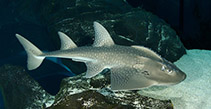
An unmistakable guitarfish with a broad, rounded snout, large, high pectoral fins, and heavy ridges of spiky thorns over the eyes and on the back and shoulders; jaws with heavily ridged, crushing teeth in undulating rows (Ref. 5578). Grey or brownish above (Ref. 5578), white below; numerous white spots dorsally on fins, body and tail; black spots on head and shoulders but no eyespots or ocelli (Ref. 3919).
Body shape (shape guide): elongated.
Inhabits coastal areas and offshore coral reefs, close inshore (Ref. 9915). Found on sand and mud bottoms (Ref. 12951). Sometimes found in the water column (Ref. 12951). Feeds on demersal bony fishes (e.g. croakers), crustaceans (crabs, prawns), bivalves, and cephalopods (Ref. 9915, 114953). Ovoviviparous (Ref. 50449). Produces litters of 2-11 pups (Ref. 114953). A row of large spines present above the eye, on the center of the nape, and on the shoulder have a defensive function (can be used for butting). Caught commonly by demersal tangle net, and occasionally trawl and longline fisheries (Ref.58048). Considered as to be a problem in trawls because it is very rough and spiky, difficult to handle and can be hazardous, thus they create a nuisance to trawl fishers as they are difficult to remove and their roughness can damage smaller species in the catch (Ref. 9915, 93660). Utilized fresh and dried-salted; the pectoral fins are the only part which is eaten (Ref. 9987).
Ciclo vitale e comportamento di accoppiamento
Maturità | Riproduzione | Deposizione | Uova | Fecondità | Larve
Exhibit ovoviparity (aplacental viviparity), with embryos feeding initially on yolk, then receiving additional nourishment from the mother by indirect absorption of uterine fluid enriched with mucus, fat or protein through specialised structures (Ref. 50449). With 4 in a litter (Ref. 12951). Size at birth 45 cm (Ref. 12951).
Compagno, L.J.V. and P.R. Last, 1999. Rhinidae (=Rhynchobatidae). Wedgefishes. p. 1418-1422. In K.E. Carpenter and V. Niem (eds.) FAO identification guide for fishery purposes. The Living Marine Resources of the Western Central Pacific. FAO, Rome. (Ref. 9915)
Stato della Lista Rossa IUCN (Ref. 130435: Version 2025-2 (Global))
Usi umani
Pesca: commerciale
Strumenti
Rapporti speciali
Scarica XML
Fonti Internet
Stime basate su modelli
Temperatura preferita (Fonte Biblio.
123201): 24.4 - 29.1, mean 28.1 °C (based on 1422 cells).
Indice di diversità filogenetica (Fonte Biblio.
82804): PD
50 = 1.0005 [Uniqueness, from 0.5 = low to 2.0 = high].
Bayesian length-weight: a=0.00372 (0.00166 - 0.00830), b=3.11 (2.91 - 3.31), in cm total length, based on LWR estimates for this (Sub)family-body shape (Ref.
93245).
Livello trofico (Fonte Biblio.
69278): 3.6 ±0.50 se; based on food items.
Resilienza (Fonte Biblio.
120179): Molto basso, tempo minimo di raddoppiamento della popolazione più di 14 anni (Fec=4).
Vulnerabilità della pesca (Ref.
59153): Very high vulnerability (90 of 100).
🛈
Nutrienti (Ref.
124155): Calcium = 6.66 [1.37, 27.05] mg/100g; Iron = 0.311 [0.072, 0.881] mg/100g; Protein = 19.5 [17.3, 21.6] %; Omega3 = 0.0694 [, ] g/100g; Selenium = 45.3 [13.9, 139.1] μg/100g; VitaminA = 26.1 [8.3, 82.9] μg/100g; Zinc = 0.722 [0.351, 1.434] mg/100g (wet weight);