Élasmobranches (requins et raies) (sharks and rays) >
Rhinopristiformes (Shovelnose rays) >
Trygonorrhinidae (Banjo rays, Fiddler rays)
Etymology: Trygonorrhina: Greek, trygon = a sting ray + Greek, rhinos = nose (Ref. 45335).
More on authors: Müller & Henle.
Environnement : milieu / zone climatique / profondeur / gamme de distribution
Écologie
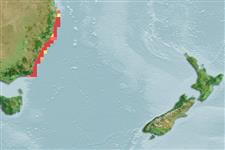
marin démersal; profondeur 0 - 100 m (Ref. 114953). Subtropical; 28°S - 38°S, 149°E - 155°E (Ref. 114953)
Southwest Pacific: endemic to eastern Australia.
Taille / Poids / Âge
Maturité: Lm ? range ? - ? cm
Max length : 120 cm TL mâle / non sexé; (Ref. 114953); poids max. publié: 6.7 kg (Ref. 6870)
Description synthétique
Clés d'identification | Morphologie | Morphométrie
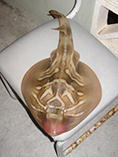
This large shovelnose ray is distinguished by the following characters: suboval disc, short and broadly rounded snout with nostrils partly covered with a large nasal curtain; sharp thorns present on mid-line of disc and shoulders; behind interorbital space is an ornate pattern of dark-edged bands with distinct triangular or diamond-shaped marking (Ref. 114953).
Body shape (shape guide): other; Cross section: flattened.
A benthic species and an active scavenger which will enter fish traps and often becoming ensnared by the disc (Ref. 6871). Found also on sandy bottoms and seagrass areas, often near rocky reefs (Ref. 12951). Mainly feeds on crabs and shrimps (Ref. 114953). Ovoviviparous with golden egg capsules, each with up to 3 embryos (Ref. 12951). Produces up to 2-3 pups. Length size seldom exceeds 110 cm TL; birth size at ca. 25 cm TL (Ref. 114953). The flesh is good to eat, although only a small quantity is sold in seafood outlets (Ref. 6871).
Cycle de vie et comportement reproducteur
Maturité | Reproduction | Frai | Œufs | Fécondité | Larves
Exhibit ovoviparity (aplacental viviparity), with embryos feeding initially on yolk, then receiving additional nourishment from the mother by indirect absorption of uterine fluid enriched with mucus, fat or protein through specialised structures (Ref. 50449).
Last, P.R., W.T. White, M.R. de Carvalho, B. Séret, M.F.W. Stehmann and G.J.P. Naylor, 2016. Rays of the world. CSIRO Publishing, Comstock Publishing Associates. i-ix + 1-790. (Ref. 114953)
Statut dans la liste rouge de l'IUCN (Ref. 130435: Version 2025-2 (Global))
Menace pour l'homme
Harmless
Utilisations par l'homme
Pêcheries: intérêt commercial mineur; pêche sportive: oui; Aquarium: Aquariums publics
Outils
Fatal error: Uncaught mysqli_sql_exception: Too many connections in /var/www/html/includes/speciessummary.lib.php:1888
Stack trace:
#0 /var/www/html/includes/speciessummary.lib.php(1888): mysqli->__construct('mysql', 'fbuser', Object(SensitiveParameterValue), 'fbquizv2', '3306')
#1 /var/www/html/summary/SpeciesSummary.php(1851): checkRecordDisplayFBQuizV2('8733', 'PicList')
#2 {main}
thrown in /var/www/html/includes/speciessummary.lib.php on line 1888