Ambiente: milieu / zona climática / intervalo de profundidade / gama de distribuição
Ecologia
; Água doce demersal; intervalo de profundidade 0 - 60 m (Ref. 34291), usually 0 - 20 m (Ref. 34291). Tropical; 25°C - 30°C (Ref. 2059)
Africa: subspecies Protopterus aethiopicus aethiopicus distributed in Nile basin and lakes Albert, Edward, Victoria, Nabugabo, Tanganyika, Kyoga and No (Ref. 3498), also in Lake Turkana (Ref. 52331). Subspecies P. a. congicus distributed in Congo basin, from Upper Lualaba to Kinshasa (Ref. 3498). Subspecies P. a. mesmaekersi distributed in Lower Congo River basin (Ref. 3498).
Comprimento na primeira maturidade / Tamanho / Peso / Idade
Maturidade: Lm 73.0, range 70 - 76 cm
Max length : 200 cm TL macho/indeterminado; (Ref. 34290); common length : 130 cm TL macho/indeterminado; (Ref. 34290); peso máx. Publicado: 17.0 kg (Ref. 13302)
Descrição breve
Chaves de identificação | Morfologia | Morfometria
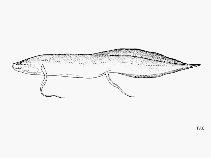
Smooth, slimy, cylindrical body with deeply embedded scales (Ref. 28714). Tail pointed and confluent with the long dorsal and anal fins; dorsal fin originating at an equal distance from eye and vent, or nearer to the latter; pectoral and pelvic fins slender and filamentous (Ref. 34290). Perpendicular from dorsal fin origin closer to posterior than to anterior limbs (Bailey 1994). 55-70 scales in a longitudinal series from immediately behind head to above vent; 40-50 scales around body (Ref. 4903, 45485). 37-40 pairs of ribs (Ref. 4903). Dentition consisting of upper and lower tooth plates in the form of sharp cutting ridges (Ref. 34290). Young fish with true external gills, but usually absent in specimens above 15 cm TL (Ref. 34290). Dark slate-grey above, yellowish-grey or pinkish below, often with numerous dark spots or flecks on fins and body; some specimens bright yellow ventrally; sensory canals on head and body outlined in black (Ref. 34290).
Body shape (shape guide): elongated; Cross section: circular.
Obligate air-breathing (Ref. 126274); Adults inhabit river and lake fringes, swamps and floodplains (Ref. 28714). In the Lake Victoria basin found in open lakes and marginal swamps, while in the Lake Tanganyika basin only found near rivers and deltas (Ref. 4967). Juveniles occur in matted roots of papyrus (Ref. 34291). Adults able to survive in streams and swamps that are completely dry for long periods of the year, withstanding desiccation on floodplains by aestivating in cocoons until the next rains, breathing air by a small passage leading to the outside (Ref. 45484). Obligate air-breather (Ref. 126274) under laboratory conditions (Ref. 34291), but under certain conditions lungfish in the wild may not be obligate air-breathers and the use of aerial respiration may be a function of ecological as well as physiological factors (Ref. 58531). Mature individuals breed during the flood season (Ref. 28714). One or several females spawn in burrows which are dug and cleaned by the male, who later guards the eggs and the young. Principal diet of adults and sub-adults consists of mollusks, but small fishes and insects are also eaten in small quantities; young individuals less than 35 cm TL feed almost exclusively on insects (Ref. 34291).
Male parent prepares a pit or hole nest, in which more than one female may spawn; once eggs are laid, female leaves the nest and does not return; male guards eggs and young for nearly eight weeks; male not only attacks any would-be intruders but also constantly aerates the water in the nest (Ref. 4903). A multiple spawner (Ref. 41824).
Gosse, J.-P., 1984. Protopteridae. p. 8-17. In J. Daget, J.-P. Gosse and D.F.E. Thys van den Audenaerde (eds.) Check-list of the freshwater fishes of Africa (CLOFFA). Volume I. ORSTOM, Paris and MRAC, Tervuren. 410 p. (Ref. 3498)
Categoria na Lista Vermelha da IUCN (Ref. 130435: Version 2025-2 (Global))
Ameaça para o homem
Harmless
Utilização humana
Pescarias: pouco comercial
Ferramentas
Relatórios especiais
Descarregue XML
Fontes da internet
Estimativas baseadas em modelos
Índice de diversidade filogenética (Ref.
82804): PD
50 = 0.6562 [Uniqueness, from 0.5 = low to 2.0 = high].
Bayesian length-weight: a=0.00380 (0.00151 - 0.00959), b=3.10 (2.88 - 3.32), in cm total length, based on LWR estimates for this (Sub)family-body shape (Ref.
93245).
Nível Trófico (Ref.
69278): 4.4 ±0.2 se; based on diet studies.
Resiliência (Ref.
120179): Baixo, tempo mínimo de duplicação da população 4,5 - 14 anos (Fec=7,800; assumed tm<10; assumed tmax>30).
Vulnerabilidade da pesca (Ref.
59153): Very high vulnerability (90 of 100).
🛈
Nutrientes (Ref.
124155): Calcium = 25.8 [5.5, 74.8] mg/100g; Iron = 0.837 [0.318, 5.003] mg/100g; Protein = 3.82 [0.22, 7.64] %; Omega3 = 0.27 [0.09, 0.82] g/100g; Selenium = 80.5 [25.2, 263.4] μg/100g; VitaminA = 17.4 [6.0, 48.3] μg/100g; Zinc = 0.886 [0.435, 1.682] mg/100g (wet weight);