Umwelt: Milieu / Klimazone / Tiefenbereich / Verbreitungsgebiet
Ökologie
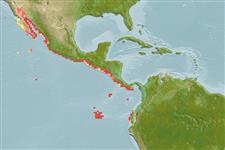
seewasser riff-verbunden; standorttreu; tiefenbereich ? - 80 m (Ref. 55763), usually 30 - ? m (Ref. 89707). Tropical; 32°N - 3°S, 115°W - 80°W (Ref. 5222)
Eastern Pacific: Gulf of California to Ecuador and the Galapagos Islands.
Größe / Gewicht / Alter
Geschlechtsreife: Lm ? range ? - ? cm
Max length : 39.0 cm TL Männchen/unbestimmt; (Ref. 89707); common length : 20.0 cm TL Männchen/unbestimmt; (Ref. 55763)
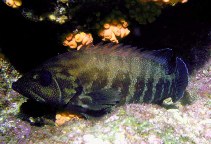
Rückenflossenstacheln (insgesamt) : 9; Rückenflossenweichstrahlen (insgesamt) : 14 - 15; Afterflossenstacheln: 3; Afterflossenweichstrahlen: 8. Distinguished by the following characteristics: body depth 2.7-2.9 in SL; head length 2.3-2.5 in SL; rounded preopercle, finely serrate; posterior and anterior nostril subequal; third dorsal spine, longest, membranes incised between anterior spines; pectoral fins longer than pelvic fins, pectoral fin length 1.5-1.7 in head length; caudal fin rounded; lateral body scales strongly ctenoid; lateral line scales 48-49; lateral scale series 80-83 (Ref. 089707)
Body shape (shape guide): fusiform / normal; Cross section: oval.
Found in coral reefs; also along rocky shores (Ref. 5222). A shy and secretive species (Ref. 5222). Feeds on fishes and crustaceans; reaches at least 25 years; recently confirmed as a protogynous hermaphrodite, spawning peaks in July and August in the Gulf of California (Ref. 089707).
Lebenszyklus und Paarungsverhalten
Geschlechtsreife | Fortpflanzung | Ablaichen | Eier | Fruchtbarkeit | Larven
Heemstra, P.C. and J.E. Randall, 1993. FAO Species Catalogue. Vol. 16. Groupers of the world (family Serranidae, subfamily Epinephelinae). An annotated and illustrated catalogue of the grouper, rockcod, hind, coral grouper and lyretail species known to date. Rome: FAO. FAO Fish. Synop. 125(16):382 p. (Ref. 5222)
IUCN Rote Liste Status (Ref. 130435: Version 2025-2 (Global))
Bedrohung für Menschen
Harmless
Nutzung durch Menschen
Sportfisch: ja
Tools
Zusatzinformationen
Download XML
Internet Quellen
Schätzungen auf der Grundlage von Modellen
Bevorzugte Temperatur (Ref.
123201): 17.9 - 26, mean 23.4 °C (based on 14 cells).
Phylogenetischer Diversitätsindex (Ref.
82804): PD
50 = 0.5000 [Uniqueness, from 0.5 = low to 2.0 = high].
Bayesian length-weight: a=0.01479 (0.00861 - 0.02542), b=3.08 (2.94 - 3.22), in cm total length, based on LWR estimates for this species & Genus-body shape (Ref.
93245).
Trophische Ebene (Ref.
69278): 4.1 ±0.7 se; based on size and trophs of closest relatives
Widerstandsfähigkeit (Ref.
120179): mittel, Verdopplung der Population dauert 1,4 - 4,4 Jahre. (tmax=4; k=0.19).
Anfälligkeit der Fischerei (Ref.
59153): Low to moderate vulnerability (29 of 100).
🛈
Nährstoffe (Ref.
124155): Calcium = 43.7 [25.8, 74.6] mg/100g; Iron = 0.523 [0.299, 0.967] mg/100g; Protein = 18.4 [16.6, 20.1] %; Omega3 = 0.167 [0.108, 0.262] g/100g; Selenium = 36.7 [20.7, 60.7] μg/100g; VitaminA = 186 [65, 595] μg/100g; Zinc = 0.803 [0.578, 1.278] mg/100g (wet weight);