Elasmobranchii (tubarões e raias) (sharks and rays) >
Carcharhiniformes (Ground sharks) >
Carcharhinidae (Requiem sharks)
Etymology: Carcharhinus: karcharos (Gr.), sharp or jagged; rhinus, an ancient name for sharks, from rhine (Gr.), rasp, both words alluding to a shark's jagged, rasp-like skin (See ETYFish); porosus: Latin for pored or full of holes, probably referring to large and conspicuous pores behind eye (See ETYFish).
Ambiente: milieu / zona climática / intervalo de profundidade / gama de distribuição
Ecologia
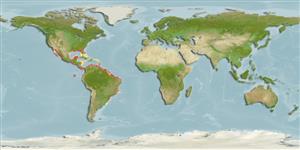
marinhas; estuarina demersal; intervalo de profundidade ? - 36 m (Ref. 9253), usually 16 - 32 m (Ref. 96339). Subtropical; 33°N - 36°S, 116°W - 33°W (Ref. 55189)
Western Atlantic: upper Gulf of Mexico, to southern Brazil; recorded from Uruguay (Ref. 58839). Specimens of porosus from Borneo, Viet Nam and Thailand may represent an undescribed small species of Carcharhinus.
Comprimento na primeira maturidade / Tamanho / Peso / Idade
Maturidade: Lm 70.0 range ? - 84 cm
Max length : 150 cm TL macho/indeterminado; (Ref. 244); common length : 90.0 cm TL macho/indeterminado; (Ref. 9253)
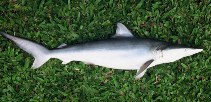
This species is a smooth-backed (lacking an interdorsal ridge) shark, with a low first dorsal fin originating over or behind the pectoral fin free rear tip. Adults' first dorsal fin anterior margin (from the origin of the fin to its apex) is as long as the distance from the apex to the free rear tip, so that apex makes an equilateral triangle with its origin and free rear tip; height of the first dorsal fin is about 8-9% of the total length. The second dorsal fin originates over the midpoint of the anal fin base. The caudal fin measures about one fourth of the total length. A series of conspicuous pores (hyomandibular pores) are located behind the eye. The upper teeth have long triangular cusps that become increasingly oblique towards the corners of the mouth, these have a weak notch or lack a notch on their medial edges, and a strong notch on the outer edges. Edges of the first four teeth have coarse serrations from the bases up to the notch and finer serrations from the notch to the tip and these coarse serrations disappear by the fifth or sixth tooth. Subsequent teeth have inner edges with uniform fine serrations from base to tip. The five or six outermost upper teeth have strongly oblique cusps with nearly straight inner margins and a strong notch on the outer margin while the lower teeth are erect and have cusps with a few coarse serrations at their bases and finer serrations towards the tips. Teeth number U:14-1-14; L:13-13. Dermal denticles are characteristic with a central strong ridge terminating in a long point, and two shorter ridges on wing-like sides; dorsal surface of the denticles has a coarse microsculpture. Body color gray above and dirty white below, unmarked fins (Ref. 86285).
Body shape (shape guide): fusiform / normal.
Found in the continental shelves, preferably over muddy bottoms, and especially in estuaries. Feeds mainly on small fishes including young hammerhead and sharpnose sharks, and shrimps. Viviparous, with 2 to 7 young in a litter. Size at birth between 31 and 40 cm. Utilized fresh for human consumption and processed for fishmeal, and liver extracted for oil.
Viviparous, placental (Ref. 50449). Distinct pairing with embrace (Ref. 205).
Compagno, L.J.V., 1984. FAO Species Catalogue. Vol. 4. Sharks of the world. An annotated and illustrated catalogue of shark species known to date. Part 2 - Carcharhiniformes. FAO Fish. Synop. 125(4/2):251-655. Rome: FAO. (Ref. 244)
Categoria na Lista Vermelha da IUCN (Ref. 130435: Version 2025-2 (Global))
Ameaça para o homem
Harmless
Utilização humana
Pescarias: pouco comercial
Ferramentas
Relatórios especiais
Descarregue XML
Fontes da internet
Estimativas baseadas em modelos
Temperatura preferida (Ref.
123201): 22.5 - 27.9, mean 25.5 °C (based on 206 cells).
Índice de diversidade filogenética (Ref.
82804): PD
50 = 0.5000 [Uniqueness, from 0.5 = low to 2.0 = high].
Bayesian length-weight: a=0.00407 (0.00249 - 0.00666), b=3.06 (2.92 - 3.20), in cm total length, based on LWR estimates for this species & Genus-body shape (Ref.
93245).
Nível Trófico (Ref.
69278): 4.1 ±0.6 se; based on diet studies.
Generation time: 14.5 ( na - na) years. Estimated as median ln(3)/K based on 2
growth studies.
Resiliência (Ref.
120179): Muito baixo, tempo mínimo de duplicação da população maior que 14 anos (K=0.08; tm=6; tmax=12; assuming Fec<10).
Vulnerabilidade da pesca (Ref.
59153): Very high vulnerability (77 of 100).
🛈