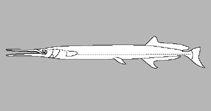
>
Beloniformes (Needle fishes) >
Belonidae (Needlefishes)
Etymology: Strongylura: Greek, strongylos = round + Greek, oura = tail (Ref. 45335).
Eponymy: Johann Ludwig (Louis) Gerard Krefft (1830–1881) was a German-born Australian adventurer, artist, zoologist and palaeontologist. [...] (Ref. 128868), visit book page.
More on author: Günther.
Environnement : milieu / zone climatique / profondeur / gamme de distribution
Écologie
; eau douce; saumâtre pélagique; profondeur 0 - ? m. Tropical; 4°S - 24°S
Asia and Oceania: New Guinea and Australia.
Taille / Poids / Âge
Maturité: Lm ? range ? - ? cm
Max length : 85.0 cm SL mâle / non sexé; (Ref. 44894)
Description synthétique
Clés d'identification | Morphologie | Morphométrie
Rayons mous dorsaux (Total) : 16 - 18; Rayons mous anaux: 19 - 20.
Inhabits still or flowing rivers, from tidal reaches to far inland. Also found in some impoundments (Lake Argyle,WA). Often shelters among overhanging vegetation or submerged roots. Adults are infrequently found in coastal marine waters (Ref. 44894). Occurs in larger streams. Surface-dwelling predator of small fishes, insects (Ref. 205, 44894) and crustaceans (Ref. 44894). Oviparous (Ref. 205). Spawning is believed to occur sometimes between September and December. The presence of juveniles well inland and in impoundments suggests that it may spawn in freshwater (Ref. 44894). Eggs may be found attached to objects in the water by tendrils on the egg's surface (Ref. 205).
Cycle de vie et comportement reproducteur
Maturité | Reproduction | Frai | Œufs | Fécondité | Larves
Oviparous (Ref. 205). Breeding occurs in shallow seas, estuaries, freshwater rivers, lakes or ponds (Ref. 205).
Allen, G.R., 1989. Freshwater fishes of Australia. T.F.H. Publications, Inc., Neptune City, New Jersey. (Ref. 5259)
Statut dans la liste rouge de l'IUCN (Ref. 130435: Version 2025-2 (Global))
Menace pour l'homme
Traumatogenic
Utilisations par l'homme
Pêcheries: commercial; Aquarium: Aquariums publics
Outils
Articles particuliers
Télécharger en XML
Sources Internet
Estimations basées sur des modèles
Indice de diversité phylogénétique (Réf.
82804): PD
50 = 0.5000 [Uniqueness, from 0.5 = low to 2.0 = high].
Bayesian length-weight: a=0.00135 (0.00059 - 0.00307), b=3.09 (2.91 - 3.27), in cm total length, based on LWR estimates for this Genus-body shape (Ref.
93245).
Niveau trophique (Réf.
69278): 3.6 ±0.55 se; based on food items.
Résilience (Réf.
120179): Milieu, temps minimum de doublement de population : 1,4 à 4,4 années (Preliminary K or Fecundity.).
Vulnérabilité de la pêche (Ref.
59153): High vulnerability (62 of 100).
🛈