>
Pleuronectiformes (Flatfishes) >
Paralichthyidae (Large-tooth flounders)
Etymology: Pseudorhombus: Greek, pseudes = false + Greek, rhombos = paralelogram (Ref. 45335).
Eponymy: Reverend Leonard Jenyns (1800–1893) was a clergyman and amateur naturalist. [...] (Ref. 128868), visit book page.
More on author: Bleeker.
Entorno: milieu / zona climática / rango de profundidad / gama de distribución
Ecología
marino; salobre demersal; rango de profundidad ? - 150 m (Ref. 9563). Subtropical
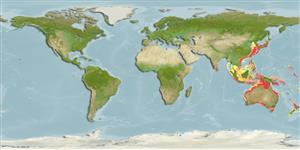
Indo-West Pacific: most coasts of Australia.
Tamaño / Peso / Edad
Madurez: Lm ? range ? - ? cm
Max length : 34.0 cm TL macho / no sexado; (Ref. 3132); common length : 22.5 cm SL macho / no sexado; (Ref. 9774); peso máximo publicado: 1.5 kg (Ref. 3132)
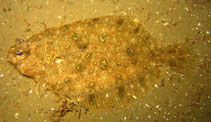
Espinas dorsales (total) : 0; Radios blandos dorsales (total) : 65 - 74; Espinas anales: 0; Radios blandos anales: 51 - 60. Body brownish, 2 conspicuous ocelli above and below lateral line and 1 or 2 ocelli on posterior part of straight section of lateral line, a dark blotch at junction of straight and curved portions of lateral line. Upper profile of head distinctly notched in front of upper eye. A line connecting base of first dorsal-fin ray and posterior nostril on eyed side crosses maxilla. Origin of dorsal fin slightly before anterior margin of upper eye and just above or behind posterior nostril on blind side. Pectoral fin on ocular side with 11-12 soft rays (Ref 9774).
Body shape (shape guide): short and / or deep.
Occurs in estuaries and offshore over sand or mud bottoms (Ref. 9563). Feeds on various benthic animals (Ref. 9774). Marketed fresh (Ref. 9774) and is considered an excellent food fish.
Ciclo vital y comportamiento de apareamiento
Madurez | Reproducción | Puesta | Huevos | Fecundidad | Larva
Distinct pairing (Ref. 205).
Robins, C.R., R.M. Bailey, C.E. Bond, J.R. Brooker, E.A. Lachner, R.N. Lea and W.B. Scott, 1991. World fishes important to North Americans. Exclusive of species from the continental waters of the United States and Canada. Am. Fish. Soc. Spec. Publ. (21):243 p. (Ref. 4537)
Situación en la Lista Roja de la UICN (Ref. 130435: Version 2025-2 (Global))
Amenaza para el ser humano
Harmless
Usos humanos
Pesquerías: comercial
Herramientas
Informes especiales
Descargar XML
Fuentes de Internet
Estimaciones basadas en modelos
Temperatura preferida (Referencia
123201): 15.2 - 28.7, mean 25 °C (based on 964 cells).
Índice de diversidad filogenética (Referencia
82804): PD
50 = 0.5000 [Uniqueness, from 0.5 = low to 2.0 = high].
Bayesian length-weight: a=0.00741 (0.00346 - 0.01589), b=3.17 (3.00 - 3.34), in cm total length, based on LWR estimates for this Genus-body shape (Ref.
93245).
Nivel trófico (Referencia
69278): 3.5 ±0.37 se; based on food items.
Resiliencia (Referencia
120179): Alto, población duplicada en un tiempo mínimo inferior a 15 meses (Preliminary K or Fecundity.).
Vulnerabilidad pesquera (Ref.
59153): Low vulnerability (24 of 100).
🛈
Nutrientes (Ref.
124155): Calcium = 96.9 [45.9, 222.1] mg/100g; Iron = 1 [1, 2] mg/100g; Protein = 17.6 [15.6, 19.6] %; Omega3 = 0.235 [0.125, 0.434] g/100g; Selenium = 29.5 [14.7, 60.8] μg/100g; VitaminA = 7.58 [2.15, 27.85] μg/100g; Zinc = 0.75 [0.51, 1.09] mg/100g (wet weight);