Пластиножаберные (акулы и скаты) (sharks and rays) >
Carcharhiniformes (Ground sharks) >
Carcharhinidae (Requiem sharks)
Etymology: Carcharhinus: karcharos (Gr.), sharp or jagged; rhinus, an ancient name for sharks, from rhine (Gr.), rasp, both words alluding to a shark's jagged, rasp-like skin (See ETYFish); sorrah: Tamil (Indian subcontinent) word for shark [authorship often attributed to Müller & Henle, who published Valenciennes’ description] (See ETYFish).
Окружающая среда: среда / климатическая зона / пределы глубины / диапазон распространения
экология
морской; солоноватоводный ассоциированный с рифами; пределы глубины 0 - 140 m (Ref. 30573), usually 1 - 73 m (Ref. 90102). Tropical; 31°N - 31°S
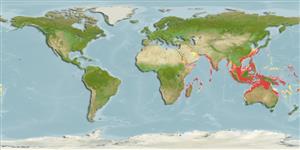
Indo-West Pacific: Persian Gulf (Ref. 68964), Red Sea and East Africa (including Madagascar, Mauritius and Seychelles) to the Philippines, north to China, south to Australia. Also from Vanikolo Island (Santa Cruz Islands) and the Solomon Islands. Possibly occurring in the Gulf of Aden, Gulf of Oman and Sri Lanka (Ref. 9997).
Длина при первой зрелости / Размер / Вес / Возраст
половая зрелость: Lm 130.0 range ? - ? cm
Max length : 160 cm TL самец/пол неопределен; (Ref. 2334); наибольший вес (опубликованные данные): 28.0 kg (Ref. 6390); наибольший возраст (опубликованны данные): 8 годы (Ref. 6390)
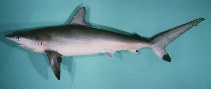
колючие лучи спинного плавника (общее число) : 0; колючие лучи анального плавника: 0. A small, spindle-shaped shark with a long, rounded snout, large circular eyes, and oblique-cusped serrated teeth; 2nd dorsal fin very low; interdorsal ridge present (Ref. 5578). 2nd dorsal, pectorals and lower caudal lobe with dark tips; 1st dorsal with thin but conspicuous dark tip; pelvic fins and upper caudal lobe plain (Ref. 5485). Grey or grey-brown above, white below with a golden-brown sheen on the area between eyes and gill slits (in fresh specimens); pectorals, second dorsal, and lower caudal fin lobe with conspicuous black tips, first dorsal and upper caudal fin lobe with black edging (Ref. 9997). A dark band on flank extending rearwards to pelvic fins (Ref. 9997).
Body shape (shape guide): fusiform / normal.
Found on the continental and insular shelves, primarily near reefs (Ref. 244). Sometimes in offshore waters (Ref. 30573). Live near the seabed during the day and near the surface at night (Ref. 6390). Feeds on bony fishes (Ref. 68964). Shark movements often short (50 km) but may be more than 1,000 km (Ref. 6390). Prefers teleost fishes but also feeds on cephalopods and crustaceans (Ref. 6871). Viviparous (Ref. 50449). Regularly caught by local artisanal and small-scale commercial fisheries where it occurs (Ref. 244). Utilized as a food fish; fins used in the oriental shark fin trade, liver for vitamin oil, and offal for fishmeal (Ref. 9997).
Viviparous, with a yolk-sac placenta (Ref. 244). Pups, average 3, range 1-8, are produced in January after a 10-month gestation period. Average length at birth is 50 cm TL. Length increases by about 25 cm during the first year. These sharks breed once each year (Ref. 13440). Distinct pairing with embrace (Ref. 205).
Compagno, L.J.V., 1984. FAO Species Catalogue. Vol. 4. Sharks of the world. An annotated and illustrated catalogue of shark species known to date. Part 2 - Carcharhiniformes. FAO Fish. Synop. 125(4/2):251-655. Rome: FAO. (Ref. 244)
Статус Красного Списка МСОП (Ref. 130435: Version 2025-2 (Global))
Использование человеком
рыболовство: не имеет хозяйственного значения
дополнительная информация
инструменты
Специальные отчеты
Скачать в формате XML
ресурсы в Интернет
Оценки, основанные на моделях
Предпочтительная температура (ссылка
123201): 24.5 - 29, mean 27.8 °C (based on 2844 cells).
Индекс филогенетического разнообразия (ссылка
82804): PD
50 = 0.5000 [Uniqueness, from 0.5 = low to 2.0 = high].
Bayesian length-weight: a=0.00355 (0.00205 - 0.00615), b=3.16 (3.02 - 3.30), in cm total length, based on LWR estimates for this species & Genus-body shape (Ref.
93245).
Трофический уровень (ссылка
69278): 4.2 ±0.5 se; based on diet studies.
Generation time: 3.2 ( na - na) years. Estimated as median ln(3)/K based on 2
growth studies.
устойчивость к внешним воздействиям (ссылка
120179): низкий, минимальное время удвоения популяции 4.5-14 лет (K=0.34; tm=2-3; tmax=8; Fec=3).
Prior r = 0.28, 95% CL = 0.19 - 0.42, Based on 1 data-limited stock assessment.
Уязвимость рыбной ловли (Ref.
59153): Moderate to high vulnerability (50 of 100).
🛈
Климатическая уязвимость (Ref.
125649): Very high vulnerability (90 of 100).
🛈
Питательные вещества (Ref.
124155): Calcium = 8.62 [1.61, 44.76] mg/100g; Iron = 0.433 [0.105, 1.215] mg/100g; Protein = 22.5 [19.7, 24.7] %; Omega3 = 0.127 [0.051, 0.297] g/100g; Selenium = 32.8 [8.5, 90.3] μg/100g; VitaminA = 44.4 [14.6, 133.4] μg/100g; Zinc = 0.637 [0.305, 1.261] mg/100g (wet weight);