>
Scombriformes (Mackerels) >
Scombridae (Mackerels, tunas, bonitos) > Scombrinae
Etymology: Acanthocybium: Greek, akantha = thorn + Greek, kybion. -ou = a tunna (Ref. 45335).
Eponymy: Daniel Carl [Karl] Solander (1733–1782) was a Swedish naturalist and explorer who was one of Linnaeus’s pupils at Uppsala. [...] (Ref. 128868), visit book page.
More on author: Cuvier.
Ambiente: milieu / zona climatica / distribuzione batimetrica / gamma di distribuzione
Ecologia
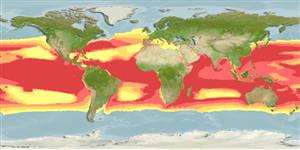
marino pelagic-oceanic; oceanodromo (Ref. 51243); distribuzione batimetrica 0 - 20 m (Ref. 89972), usually 0 - 12 m (Ref. 5227). Subtropical; 59°N - 48°S, 180°W - 180°E
Atlantic, Indian and Pacific Oceans: in tropical and subtropical waters, including the Caribbean and Mediterranean seas.
Lunghezza alla prima maturità / Dimensione / Peso / Età
Maturità: Lm 99.3, range 85 - 105 cm
Max length : 250 cm TL maschio/sesso non determinato; (Ref. 30573); common length : 170 cm FL maschio/sesso non determinato; (Ref. 9340); peso massimo pubblicato: 83.0 kg (Ref. 168)
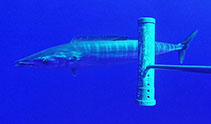
Spine dorsali (totale) : 23 - 27; Raggi dorsali molli (totale) : 12 - 16; Spine anali: 0; Raggi anali molli: 12 - 14; Vertebre: 62 - 64. Mouth large with strong, triangular, compressed and finely serrate teeth. Snout about as long as the rest of head. Posterior part of maxilla completely concealed under preorbital bone. Gill rakers absent. Interpelvic process small and bifid. Swim bladder present. Body covered with small scales. No anterior corselet developed. The back is iridescent bluish green; the sides silvery with 24 to 30 cobalt blue vertical bars which extend to below the lateral line.
Body shape (shape guide): elongated; Cross section: oval.
An oceanic, epipelagic species frequently solitary or forming small loose aggregations rather than compact schools. Feed on fishes and squids. Eggs and larvae are pelagic (Ref. 6769). An important sport fish in some areas (Ref. 9340). Marketed fresh, salted or spice-cured slices of meat; also frozen (Ref. 9987). Flesh of very good quality (Ref. 9684). Minimum depth from Ref. 005227.
Spawning seems to extend over a long period; fish in different maturity stages are frequently caught at the same time.
Collette, B.B. and C.E. Nauen, 1983. FAO Species Catalogue. Vol. 2. Scombrids of the world. An annotated and illustrated catalogue of tunas, mackerels, bonitos and related species known to date. Rome: FAO. FAO Fish. Synop. 125(2):137 p. (Ref. 168)
Stato della Lista Rossa IUCN (Ref. 130435: Version 2025-2 (Global))
Minaccia per l'uomo
Reports of ciguatera poisoning (Ref. 30298)
Usi umani
Pesca: commerciale; Pesce da pesca sportiva: si
Strumenti
Rapporti speciali
Scarica XML
Fonti Internet
Stime basate su modelli
Temperatura preferita (Fonte Biblio.
123201): 18.2 - 27.6, mean 24.7 °C (based on 46871 cells).
Indice di diversità filogenetica (Fonte Biblio.
82804): PD
50 = 1.0000 [Uniqueness, from 0.5 = low to 2.0 = high].
Bayesian length-weight: a=0.00288 (0.00207 - 0.00402), b=3.16 (3.06 - 3.26), in cm total length, based on LWR estimates for this species (Ref.
93245).
Livello trofico (Fonte Biblio.
69278): 4.3 ±0.2 se; based on diet studies.
Resilienza (Fonte Biblio.
120179): Medio, tempo minimo di raddoppiamento della popolazione 1.4 - 4.4 anni (K=0.34; tm=1-2 y; tmax >4; Fec=6 million).
Prior r = 0.84, 95% CL = 0.55 - 1.26, Based on 1 full stock assessment.
Vulnerabilità della pesca (Ref.
59153): Moderate to high vulnerability (46 of 100).
🛈
Vulnerabilità climatica (Ref.
125649): Very high vulnerability (76 of 100).
🛈
Nutrienti (Ref.
124155): Calcium = 34.8 [17.2, 70.3] mg/100g; Iron = 1.34 [0.70, 2.53] mg/100g; Protein = 21.8 [20.5, 23.1] %; Omega3 = 0.183 [0.092, 0.379] g/100g; Selenium = 28 [13, 64] μg/100g; VitaminA = 6.92 [2.08, 25.10] μg/100g; Zinc = 0.423 [0.273, 0.649] mg/100g (wet weight);