Environnement : milieu / zone climatique / profondeur / gamme de distribution
Écologie
; eau douce benthopélagique. Tropical; 8°N - 3°N
Africa: Meme, Mungo (Ref. 52307, 81260) and Wouri Rivers, Cameroon (Ref. 81260).
Taille / Poids / Âge
Maturité: Lm ? range ? - ? cm
Max length : 13.6 cm TL mâle / non sexé; (Ref. 5163)
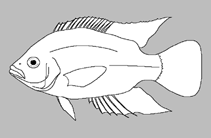
Épines dorsales (Total) : 16; Rayons mous dorsaux (Total) : 11 - 12; Épines anales: 3; Rayons mous anaux: 8 - 9. Diagnosis: 9 or fewer rakers on lower limb of first arch; dorsal fin with 16 spines and 11-12 soft rays; soft dorsal with blackish streaks that curve forward above the "tilapia spot" and become more longitudinal in orientation (Ref. 81260).
Probably pair-bonding, open (Ref. 52307) substrate brooder/spawner (Ref. 52307, 81260), with both parents guarding the brood (Ref. 52307).
Cycle de vie et comportement reproducteur
Maturité | Reproduction | Frai | Œufs | Fécondité | Larves
Dunz, A.R. and U.K. Schliewen, 2013. Molecular phylogeny and revised classification of the haplotilapiine cichlid fishes formerly referred to as "Tilapia". Mol. Phylogenet. Evol. 68(1):64-80. (Ref. 93285)
Statut dans la liste rouge de l'IUCN (Ref. 130435: Version 2025-2 (Global))
Menace pour l'homme
Harmless
Utilisations par l'homme
Outils
Articles particuliers
Télécharger en XML
Sources Internet
Estimations basées sur des modèles
Indice de diversité phylogénétique (Réf.
82804): PD
50 = 0.5000 [Uniqueness, from 0.5 = low to 2.0 = high].
Bayesian length-weight: a=0.01905 (0.00846 - 0.04293), b=3.01 (2.82 - 3.20), in cm total length, based on LWR estimates for this (Sub)family-body shape (Ref.
93245).
Niveau trophique (Réf.
69278): 2.6 ±0.1 se; based on size and trophs of closest relatives
Résilience (Réf.
120179): Haut, temps minimum de doublement de population inférieur à 15 mois (Preliminary K or Fecundity.).
Vulnérabilité de la pêche (Ref.
59153): Low vulnerability (10 of 100).
🛈