Elasmobranchii (Haie und Rochen) (sharks and rays) >
Rajiformes (Skates and rays) >
Rajidae (Skates)
Etymology: Rajella: Latin, raja, -ae = a sting ray (Raja sp.) (Ref. 45335).
Umwelt: Milieu / Klimazone / Tiefenbereich / Verbreitungsgebiet
Ökologie
seewasser bathydemersal; tiefenbereich 400 - 1640 m (Ref. 106604). Deep-water; 15°N - 34°S
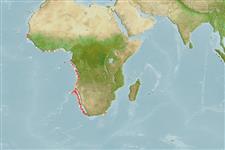
Eastern Atlantic: off southern Rio de Oro in Western Sahara, Namibia, and South Africa. Probably occurs throughout the area along the deeper West African slope.
Größe / Gewicht / Alter
Geschlechtsreife: Lm ? range ? - ? cm
Max length : 82.3 cm TL Männchen/unbestimmt; (Ref. 106604)
Kurzbeschreibung
Bestimmungsschlüssel | Morphologie | Morphometrie
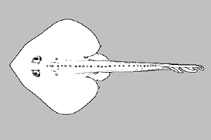
Moderately long snout, small eyes, and a flat disc; tail about as long as body; moderately large, inconspicuous light thorns dorsally and a few on snout; mid-dorsal line of thorns reduced in adolescents and adults (Ref. 5578). Whitish grey to dark grey dorsally, white ventrally with dark rear margins and dark patches on underside of tail (Ref. 5578).
Body shape (shape guide): other.
Found in deeper slope waters (Ref. 4426). Feed on cephalopods, mysids and small bony fishes (Ref. 5578). Oviparous (Ref. 50449). Eggs have horn-like projections on the shell (Ref. 205).
Lebenszyklus und Paarungsverhalten
Geschlechtsreife | Fortpflanzung | Ablaichen | Eier | Fruchtbarkeit | Larven
Oviparous, paired eggs are laid. Embryos feed solely on yolk (Ref. 50449).
McEachran, J.D. and K.A. Dunn, 1998. Phylogenetic analysis of skates, a morphologically conservative clade of elasmobranchs (Chondrichthyes: Rajidae). Copeia 1998(2):271-290. (Ref. 27314)
IUCN Rote Liste Status (Ref. 130435: Version 2025-2 (Global))
Bedrohung für Menschen
Harmless
Nutzung durch Menschen
Fischereien: nicht kommerziell
Tools
Zusatzinformationen
Download XML
Internet Quellen
Schätzungen auf der Grundlage von Modellen
Bevorzugte Temperatur (Ref.
123201): 3.3 - 6.6, mean 4.3 °C (based on 24 cells).
Phylogenetischer Diversitätsindex (Ref.
82804): PD
50 = 0.5000 [Uniqueness, from 0.5 = low to 2.0 = high].
Bayesian length-weight: a=0.00288 (0.00176 - 0.00474), b=3.29 (3.15 - 3.43), in cm total length, based on LWR estimates for this species & (Sub)family-body (Ref.
93245).
Trophische Ebene (Ref.
69278): 4.0 ±0.53 se; based on food items.
Widerstandsfähigkeit (Ref.
120179): niedrig, Verdopplung der Population dauert 4,5 - 14 Jahre. (Fec assumed to be <100).
Anfälligkeit der Fischerei (Ref.
59153): Moderate to high vulnerability (53 of 100).
🛈