Milieu: milieu / Klimaatzone / Diepte / verspreidingsgebied
Ecologie
marien demersaal; amfidroom (Ref. 51243); diepte 7 - 350 m (Ref. 58488). Tropical; 46°N - 36°S, 21°E - 164°W
Indo-West Pacific: Red Sea, East Africa eastward through northern Australia to Fiji, northward to southern Japan.
Grootte / Gewicht / Leeftijd
Maturiteit: Lm ? range ? - ? cm
Max length : 60.0 cm TL mannelijk / geslacht onbekend; (Ref. 111441); common length : 40.0 cm TL mannelijk / geslacht onbekend; (Ref. 9770)
Korte beschrijving
Determinatiesleutels | Morfologie | Morfometrie
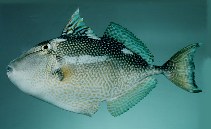
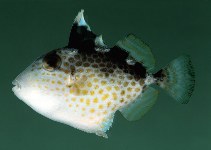
Dorsale stekels (totaal) : 3; Dorsale zachte stralen (totaal) : 25 - 27; Anale stekels: 0; Anale zachte stralen: 24 - 26. Scales enlarged above the pectoral fin base and just behind the gill slit to form a flexible tympanum; scales of posterior body with prominent keels, forming longitudinal ridges. A prominent groove in the skin extending anteriorly from front of eye for a distance of about 1 eye diameter. Caudal peduncle depressed. Caudal fin rays of adults prolonged above and below.
Body shape (shape guide): short and / or deep; Cross section: oval.
Inhabit coastal areas, usually found over muddy and sandy bottoms, also around reefs, together with the sponges and algae (Ref. 5213). Adults on deep coastal slopes and usually seen swimming high above the bottom, sometimes found in estuaries. Juveniles in sheltered coastal bays and estuaries with outcrops of rubble or debris on open substrates (Ref. 48637). Feed on benthic animals (Ref. 9769). Oviparous (Ref. 205). Also caught with vertical long-lines (Ref. 9770). Marketed fresh and dried-salted (Ref. 9770).
Levenscyclus en paargedrag
Maturiteit | Voortplanting | Paaien | Eieren | Fecunditeit | Larven
Oviparous, distinct pairing during breeding (Ref. 205).
Matsuura, K., 2001. Balistidae. Triggerfishes. p. 3911-3928. In K.E. Carpenter and V. Niem (eds.) FAO species identification guide for fishery purposes. The living marine resources of the Western Central Pacific. Vol. 6. Bony fishes part 4 (Labridae to Latimeriidae), estuarine crocodiles. FAO, Rome. (Ref. 9770)
Status op de Rode Lijst van het IUCN (Ref. 130435: Version 2025-2 (Global))
Gebruik door de mens
Visserij: commercieel; Aquarium: Commercieel
Tools
Speciale rapporten
Download XML
Internetbronnen
Schattingen op basis van modellen
Gewenste temperatuur (Ref.
123201): 22.9 - 28.3, mean 27.1 °C (based on 501 cells).
Fylogenetische diversiteitsindex (Ref.
82804): PD
50 = 0.7500 [Uniqueness, from 0.5 = low to 2.0 = high].
Bayesian length-weight: a=0.02884 (0.02344 - 0.03548), b=2.90 (2.84 - 2.96), in cm total length, based on LWR estimates for this species (Ref.
93245).
Trofisch niveau (Ref.
69278): 3.6 ±0.0 se; based on diet studies.
Weerstandsvermogen (Ref.
120179): Gemiddeld, minimale populatieverdubbelingstijd 1,4-4,4 jaar (Preliminary K or Fecundity.).
Kwetsbaarheid van de visserij (Ref.
59153): Moderate vulnerability (44 of 100).
🛈
Voedingsstoffen (Ref.
124155): Calcium = 25 [11, 64] mg/100g; Iron = 0.49 [0.25, 1.12] mg/100g; Protein = 18.4 [16.3, 20.6] %; Omega3 = 0.129 [0.063, 0.260] g/100g; Selenium = 58 [29, 125] μg/100g; VitaminA = 42 [11, 167] μg/100g; Zinc = 0.816 [0.542, 1.216] mg/100g (wet weight);