Holocephali (Chimären, Seekatzen) (chimaeras) >
Chimaeriformes (Chimaeras) >
Rhinochimaeridae (Longnose chimaeras)
Etymology: Rhinochimaera: A chimaera with rhinos (Gr.), nose, referring to long, pointed proboscis of R. pacifica (See ETYFish); atlantica: ana- (L.), belonging to: North Atlantic Ocean, where it occurs (See ETYFish).
Umwelt: Milieu / Klimazone / Tiefenbereich / Verbreitungsgebiet
Ökologie
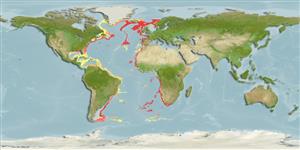
seewasser bathydemersal; tiefenbereich 200 - 1500 m (Ref. 117245), usually 400 - 1500 m (Ref. 4444). Deep-water; 67°N - 58°S, 98°W - 26°E
Northwest to Northeast Atlantic, and Southeast Atlantic: Antitropical. Eastern Atlantic: northern Bay of Biscay northward to Iceland, including the Iceland-Faroes Rise (Ref. 3183); off Cayar and Cape Barbas in Western Sahara, off Namibia and South Africa (Ref. 4444). Western Atlantic: off Nova Scotia, Canada and New England, USA (Ref. 3183).
Größe / Gewicht / Alter
Geschlechtsreife: Lm ? range ? - ? cm
Max length : 140 cm TL Männchen/unbestimmt; (Ref. 4444)
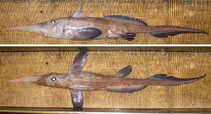
Rückenflossenstacheln (insgesamt) : 1; Afterflossenstacheln: 0; Afterflossenweichstrahlen: 0. A longnose chimaera with a narrow, moderately flattened, pointed snout and smooth, sharp-edged tooth plates; pectoral fins narrow, and caudal fin with very short terminal filament and wide-spaced tubercles on upper edge (in adults and large juveniles) (Ref. 5578). Whitish to light brown in color (Ref. 5578).
Body shape (shape guide): elongated.
Found on or near the bottom of continental slopes (Ref. 5578). Forms groups according to sex and size (Ref. 5578). Feeds on shrimps and crabs (Ref. 27637). Oviparous (Ref. 205). Eggs are encased in horny shells (Ref. 205).
Lebenszyklus und Paarungsverhalten
Geschlechtsreife | Fortpflanzung | Ablaichen | Eier | Fruchtbarkeit | Larven
Krefft, G., 1990. Rhinochimaeridae. p. 114-116. In J.C. Quero, J.C. Hureau, C. Karrer, A. Post and L. Saldanha (eds.) Check-list of the fishes of the eastern tropical Atlantic (CLOFETA). JNICT, Lisbon; SEI, Paris; and UNESCO, Paris. Vol. 1. (Ref. 4444)
IUCN Rote Liste Status (Ref. 130435: Version 2025-2 (Global))
Bedrohung für Menschen
Harmless
Nutzung durch Menschen
Fischereien: kommerziell
Tools
Zusatzinformationen
Download XML
Internet Quellen
Schätzungen auf der Grundlage von Modellen
Bevorzugte Temperatur (Ref.
123201): 3.4 - 8.9, mean 6.7 °C (based on 174 cells).
Phylogenetischer Diversitätsindex (Ref.
82804): PD
50 = 0.6270 [Uniqueness, from 0.5 = low to 2.0 = high].
Bayesian length-weight: a=0.00195 (0.00083 - 0.00455), b=3.14 (2.94 - 3.34), in cm total length, based on LWR estimates for this (Sub)family-body shape (Ref.
93245).
Trophische Ebene (Ref.
69278): 3.9 ±0.46 se; based on food items.
Widerstandsfähigkeit (Ref.
120179): niedrig, Verdopplung der Population dauert 4,5 - 14 Jahre. (Assuming Fec <100).
Anfälligkeit der Fischerei (Ref.
59153): Very high vulnerability (84 of 100).
🛈
Klimaanfälligkeit (Ref.
125649): Moderate vulnerability (38 of 100).
🛈
Nährstoffe (Ref.
124155): Calcium = 8.71 [2.52, 29.40] mg/100g; Iron = 0.36 [0.12, 0.92] mg/100g; Protein = 14.2 [9.9, 18.2] %; Omega3 = 0.262 [0.098, 0.711] g/100g; Selenium = 22.4 [6.6, 72.4] μg/100g; VitaminA = 5.02 [1.05, 22.07] μg/100g; Zinc = 0.293 [0.152, 0.567] mg/100g (wet weight);