>
Notacanthiformes (Halosaurs and deep-sea spiny eels) >
Halosauridae (Halosaurs)
Etymology: Aldrovandia: Taken from Ulisse Aldrovandi, (1522-1605), a Renaissance naturalist and physician noted by his systematic and accurate observations of plants and animals (Ref. 45335).
Eponymy: Dr Ulisse Aldrovandi (1522–1605) was an Italian naturalist. [...] (Ref. 128868), visit book page.
Umwelt: Milieu / Klimazone / Tiefenbereich / Verbreitungsgebiet
Ökologie
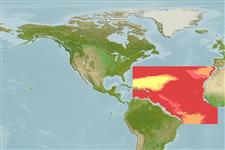
seewasser bathypelagisch; tiefenbereich 1200 - 1900 m (Ref. 4448). Deep-water; 37°N - 9°S, 74°W - 6°W
Eastern Atlantic: Gulf of Guinea region. Western Atlantic: off Virginia, USA to Bahamas, Venezuela and the Guianas. Eastern Central Pacific (Ref. 9305) and Chile (Ref. 9068).
Größe / Gewicht / Alter
Geschlechtsreife: Lm ? range ? - ? cm
Max length : 52.0 cm TL Männchen/unbestimmt; (Ref. 4448)
Rückenflossenweichstrahlen (insgesamt) : 9 - 10. Anus white, surrounded by dark field; body dark brown, head black (Ref. 13608).
Body shape (shape guide): eel-like.
Found at bathyal depths. Feeds on polychaetes. Males exhibits black tubular anterior nostrils and enlarged posterior nostrils when approaching breeding condition.
Lebenszyklus und Paarungsverhalten
Geschlechtsreife | Fortpflanzung | Ablaichen | Eier | Fruchtbarkeit | Larven
Sulak, K.J., 1990. Halosauridae. p. 126-132. In J.C. Quero, J.C. Hureau, C. Karrer, A. Post and L. Saldanha (eds.) Check-list of the fishes of the eastern tropical Atlantic (CLOFETA). JNICT, Lisbon; SEI, Paris; and UNESCO, Paris. Vol. 1. (Ref. 4448)
IUCN Rote Liste Status (Ref. 130435: Version 2025-2 (Global))
Bedrohung für Menschen
Harmless
Nutzung durch Menschen
Fischereien: nicht kommerziell
Tools
Zusatzinformationen
Download XML
Internet Quellen
Schätzungen auf der Grundlage von Modellen
Bevorzugte Temperatur (Ref.
123201): 4.2 - 6.5, mean 4.3 °C (based on 37 cells).
Phylogenetischer Diversitätsindex (Ref.
82804): PD
50 = 0.5156 [Uniqueness, from 0.5 = low to 2.0 = high].
Bayesian length-weight: a=0.00087 (0.00033 - 0.00229), b=3.07 (2.84 - 3.30), in cm total length, based on LWR estimates for this (Sub)family-body shape (Ref.
93245).
Trophische Ebene (Ref.
69278): 3.1 ±0.26 se; based on food items.
Widerstandsfähigkeit (Ref.
120179): niedrig, Verdopplung der Population dauert 4,5 - 14 Jahre. (Assuming tmax>10).
Anfälligkeit der Fischerei (Ref.
59153): Moderate vulnerability (41 of 100).
🛈