>
Notacanthiformes (Halosaurs and deep-sea spiny eels) >
Notacanthidae (Deep-sea spiny eels)
Etymology: Polyacanthonotus: Greek, poly = a lot of + Greek, akantha = thorn + Greek,noton = back (Ref. 45335).
Environnement : milieu / zone climatique / profondeur / gamme de distribution
Écologie
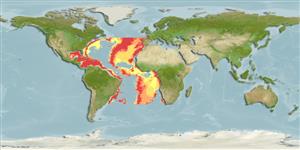
marin bathypélagique; profondeur 700 - 3000 m (Ref. 4449), usually 1500 - 2000 m (Ref. 4449). Deep-water; 45°N - 35°S, 98°W - 20°E
Eastern Atlantic: off Morocco, the Azores and Canary Islands and South Africa. Western Atlantic: New Jersey, USA to the Gulf of Mexico and Caribbean. The record from Davis Strait probably refers to Polyacanthonotus rissoanus.
Taille / Poids / Âge
Maturité: Lm ? range ? - ? cm
Max length : 50.0 cm TL mâle / non sexé; (Ref. 4449)
Description synthétique
Clés d'identification | Morphologie | Morphométrie
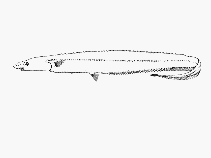
Épines dorsales (Total) : 26 - 40; Rayons mous dorsaux (Total) : 0. Off white, tan or grey in color, lateral line darker; soft rayed portion of anal dark brown (Ref. 6594). Mouth bluish in front, black behind (Ref. 6594). Opercular flap and underside of head bluish (Ref. 6594). Broad separation of the anterior and posterior nostrils. First dorsal spine well posterior to the root of the pectoral fin. Large mouth, maxillary reaching the border of spectacle and much longer preoral snout (Ref. 37108).
Body shape (shape guide): eel-like.
Found at bathyal and abyssal depths. Feeds on benthic polychaetes, cnidarians, amphipods (Ref. 4449).
Cycle de vie et comportement reproducteur
Maturité | Reproduction | Frai | Œufs | Fécondité | Larves
Sulak, K.J., 1990. Notacanthidae. p. 133-135. In J.C. Quero, J.C. Hureau, C. Karrer, A. Post and L. Saldanha (eds.) Check-list of the fishes of the eastern tropical Atlantic (CLOFETA). JNICT, Lisbon; SEI, Paris; and UNESCO, Paris. Vol. 1. (Ref. 4449)
Statut dans la liste rouge de l'IUCN (Ref. 130435: Version 2025-2 (Global))
Menace pour l'homme
Harmless
Utilisations par l'homme
Outils
Articles particuliers
Télécharger en XML
Sources Internet
Estimations basées sur des modèles
Température préférée (Réf.
123201): 3.4 - 5.3, mean 4.1 °C (based on 297 cells).
Indice de diversité phylogénétique (Réf.
82804): PD
50 = 0.5626 [Uniqueness, from 0.5 = low to 2.0 = high].
Bayesian length-weight: a=0.00102 (0.00046 - 0.00225), b=3.06 (2.88 - 3.24), in cm total length, based on all LWR estimates for this body shape (Ref.
93245).
Niveau trophique (Réf.
69278): 3.2 ±0.48 se; based on food items.
Résilience (Réf.
120179): Très faible, temps minimum de doublement de population supérieur à 14 ans (Preliminary K or Fecundity.).
Vulnérabilité de la pêche (Ref.
59153): Moderate vulnerability (40 of 100).
🛈