Echidna peli, Pebbletooth moray : fisheries

You can sponsor this page

Echidna peli (Kaup, 1856)

Pebbletooth moray
Beobachtung melden im Fish Watcher
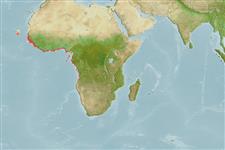
Native range
This map was computer-generated and has not yet been reviewed.
Echidna peli   AquaMaps   Data sources: GBIF OBIS
Hochladen Photos und videos
Bilder | Google Bild
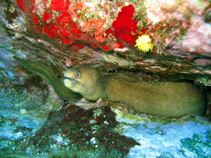
Image of Echidna peli (Pebbletooth moray)
Echidna peli
Photo von Wirtz, P.

Klassifizierung / Names Namen | Synonyme | Catalog of Fishes(Gattung, Arten) | ITIS | CoL | WoRMS | Cloffa

> Anguilliformes (Eels and morays) > Muraenidae (Moray eels) > Muraeninae
Etymology: Echidna: Greek, echidna = viper, 1847 (Ref. 45335).
Eponymy: In Greek mythology Echidna was a female monster, and mother of many other monsters including the Hydra. Hesiod described her as “half a nymph with glancing eyes and fair cheeks, and half again a huge snake, great and awful, with speckled skin.” Hendrik Severinus Pel (1818–1876) was the Dutch Governor of the Gold Coast (Ghana) (ca: 1840–1850). [...] (Ref. 128868), visit book page.
More on author: Kaup.

Umwelt: Milieu / Klimazone / Tiefenbereich / Verbreitungsgebiet Ökologie

seewasser demersal. Tropical; 21°N - 16°S

Verbreitung Territorien | FAO Gebiete | Ökosysteme | Vorkommen | Punkt Karte | Einführungen | Faunafri

Eastern Atlantic: Mauritania to Angola, including Cape Verde and the offshore islands in the Bay of Biafra.

Größe / Gewicht / Alter

Geschlechtsreife: Lm ?  range ? - ? cm
Max length : 100.0 cm TL Männchen/unbestimmt; (Ref. 27000); common length : 55.0 cm TL Männchen/unbestimmt; (Ref. 26999)

Kurzbeschreibung Bestimmungsschlüssel | Morphologie | Morphometrie


Body shape (shape guide): eel-like.

Biologie     Fachlexikon (Englisch) (z.B. epibenthic)

Occurs in rocky, shallow-water habitats. Feeds on crustaceans, small shrimps and young crabs (Ref. 3254).

Lebenszyklus und Paarungsverhalten Geschlechtsreife | Fortpflanzung | Ablaichen | Eier | Fruchtbarkeit | Larven

Hauptreferenz Laden Sie Ihre Referenzen hoch | Referenzen | Koordinator | Partner

Smith, D.G. and E.B. Böhlke, 1990. Muraenidae. p. 136-148. In J.C. Quero, J.C. Hureau, C. Karrer, A. Post and L. Saldanha (eds.) Check-list of the fishes of the eastern tropical Atlantic (CLOFETA). JNICT, Lisbon; SEI, Paris; and UNESCO, Paris. Vol. 1. (Ref. 4450)

IUCN Rote Liste Status (Ref. 130435: Version 2025-2 (Global))

  nicht bedroht (LC) ; Date assessed: 16 August 2011

CITES

Not Evaluated

CMS (Ref. 116361)

Not Evaluated

Bedrohung für Menschen

  Harmless


Nutzung durch Menschen

Fischereien: weniger kommerziell
FAO - Publication: search | FishSource |

Mehr Information

Trophische Ökologie
Lebensmittel (Beutetiere)
Nahrungszusammensetzung
Nahrungsaufnahme
Lebensmittelrationen
Räuber
Ökologie
Ökologie
Populationsdynamik
Wachstumsparameter
Max. Alter/Größen
Länge-Gewicht-Rel.
Länge-Länge-Verhältnis.
Längenhäufigkeiten
Massenkonvertierung
Rekrutierung
Dichte
Lebenszyklus
Fortpflanzung
Geschlechtsreife
Reifung/Kiemen rel.
Fruchtbarkeit
Ablaichen
Laichaggregationen
Eier
Eientwicklung
Larven
Larven Pop.Dyn.
Verbreitung
Territorien
FAO Gebiete
Ökosysteme
Vorkommen
Einführungen
BRUVS - Videos
Anatomie
Kiemenoberfläche
Gehirn
Otolith
Physiologie
Körperliche Zusammensetzung
Nährstoffe
Sauerstoffverbrauch
Schwimmart
Schwimmgeschwindigkeit
Visuelle Pigmente
Fischgeräusche
Krankheiten und Parasiten
Toxizität (LC50s)
Genetik
Genom
Genetik
Heterozygotie
Vererbbarkeit
Genetische Vielfalt
Menschenbezogen
Aquakultur-Systeme
Aquakultur Profile
Zuchtlinien
Ciguatera-Fälle
Briefmarken, Münzen, Verschiedenes.
Aufsuchen
Partner
Taxonomie
Namen
Synonyme
Morphologie
Morphometrie
Bilder
Referenzen
Referenzen

Tools

Zusatzinformationen

Download XML

Internet Quellen

AFORO (otoliths) | Aquatic Commons | BHL | Cloffa | Websites from users | FishWatcher Einträge suchen | CISTI | Catalog of Fishes: Gattung, Arten | DiscoverLife | ECOTOX | FAO - Publication: search | Faunafri | Fishipedia | Fishtrace | GloBI | Google Books | Google Scholar | Google | IGFA World Record | OneZoom | Open Tree of Life | Otolith Atlas of Taiwan Fishes | PubMed | Reef Life Survey | Socotra Atlas | TreeBase | Tree of Life | Wikipedia: Gehe zu, Suchen | World Records Freshwater Fishing | Zoologischer Rekord

Schätzungen auf der Grundlage von Modellen

Bevorzugte Temperatur (Ref. 123201): 24.4 - 28, mean 27.3 °C (based on 211 cells).
Phylogenetischer Diversitätsindex (Ref. 82804):  PD50 = 0.5005   [Uniqueness, from 0.5 = low to 2.0 = high].
Bayesian length-weight: a=0.00049 (0.00024 - 0.00099), b=3.26 (3.09 - 3.43), in cm total length, based on LWR estimates for this (Sub)family-body shape (Ref. 93245).
Trophische Ebene (Ref. 69278):  3.5   ±0.56 se; based on food items.
Widerstandsfähigkeit (Ref. 120179):  niedrig, Verdopplung der Population dauert 4,5 - 14 Jahre. (Preliminary K or Fecundity.).
Anfälligkeit der Fischerei (Ref. 59153):  High vulnerability (60 of 100). 🛈
Preiskategorie (Ref. 80766):   Medium.