Élasmobranches (requins et raies) (sharks and rays) >
Carcharhiniformes (Ground sharks) >
Carcharhinidae (Requiem sharks)
Etymology: Rhizoprionodon: rhiza (Gr.), root; prion (Gr.) saw; odon (Gr.), tooth, referring to teeth with serrated (saw-like) bases, or roots [replacement name for Rhizoprion Ogilby 1915, preoccupied by Rhizoprion Jourdan 1861 in mammals] (See ETYFish); terraenovae: terra (L.), earth or land; novus (L.), new, i.e., Newfoundland, Canada, where Richardson erroneously thought it occurred (See ETYFish).
More on author: Richardson.
Environnement : milieu / zone climatique / profondeur / gamme de distribution
Écologie
marin; saumâtre démersal; profondeur 0 - 280 m (Ref. 26938), usually 0 - 10 m (Ref. 55195). Subtropical; 43°N - 25°S, 100°W - 32°W (Ref. 55195)
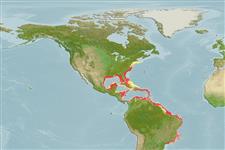
Western Atlantic: New Brunswick, Canada to the Gulf of Mexico. Southwest Atlantic: coasts of Brazil.
Longueur à la première maturité / Taille / Poids / Âge
Maturité: Lm 87.5, range 85 - 90 cm
Max length : 110 cm TL mâle / non sexé; (Ref. 37512); 110.0 cm TL (female); common length : 70.0 cm TL mâle / non sexé; (Ref. 37512); poids max. publié: 7.3 kg (Ref. 40637); âge max. reporté: 10 années (Ref. 6140)
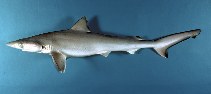
Small, generally gray, streamlined shark, with long pointed snout. Posterior margin of anal fin straight or slightly concave. Second dorsal fin origin well behind anal fin origin (Ref. 26938).
Body shape (shape guide): fusiform / normal.
Reaches at least 103 cm TL (Ref. 244). Abundant in the continental shelves, from the intertidal to deeper waters. Often occurs close to the surf zone off sandy beaches, and also enclosed bays, sounds, and harbors, in estuaries and river mouths. Feeds on small bony fishes, shrimps, crabs, segmented worms and mollusks (gastropod feet). Viviparous, with 1 to 7 young in a litter (Ref. 27549). Size at birth about 29 to 37 cm. Utilized for human consumption. Minimum depth from Ref. 055195.
Cycle de vie et comportement reproducteur
Maturité | Reproduction | Frai | Œufs | Fécondité | Larves
Distinct pairing with embrace (Ref. 205). Viviparous, placental (Ref. 50449). 1 to 7 young per litter. Larger females carry more young. Size at birth 29-37 cm. Gestation period is 10 to 11 months in the northern Gulf of Mexico. Sex ratio of near term fetuses is 1:1 (Ref. 244).
Compagno, L.J.V., 1984. FAO Species Catalogue. Vol. 4. Sharks of the world. An annotated and illustrated catalogue of shark species known to date. Part 2 - Carcharhiniformes. FAO Fish. Synop. 125(4/2):251-655. Rome: FAO. (Ref. 244)
Statut dans la liste rouge de l'IUCN (Ref. 130435: Version 2025-2 (Global))
Menace pour l'homme
Harmless
Utilisations par l'homme
Pêcheries: pêcheries vivrières; pêche sportive: oui
Outils
Articles particuliers
Télécharger en XML
Sources Internet
Estimations basées sur des modèles
Température préférée (Réf.
123201): 23.4 - 28, mean 27 °C (based on 1016 cells).
Indice de diversité phylogénétique (Réf.
82804): PD
50 = 0.5078 [Uniqueness, from 0.5 = low to 2.0 = high].
Bayesian length-weight: a=0.00417 (0.00266 - 0.00652), b=3.00 (2.87 - 3.13), in cm total length, based on LWR estimates for this species & Genus-body shape (Ref.
93245).
Niveau trophique (Réf.
69278): 4.4 ±0.5 se; based on diet studies.
Résilience (Réf.
120179): Très faible, temps minimum de doublement de population supérieur à 14 ans (K=0.19-0.45(?); tmax=10; tm=4; Fec 1-7).
Vulnérabilité de la pêche (Ref.
59153): Moderate to high vulnerability (50 of 100).
🛈
Vulnérabilité climatique (Ref.
125649): Very high vulnerability (85 of 100).
🛈
Nutriments (Ref.
124155): Calcium = 23.3 [2.5, 120.6] mg/100g; Iron = 0.89 [0.24, 2.75] mg/100g; Protein = 22.6 [19.7, 24.8] %; Omega3 = 0.372 [0.150, 0.861] g/100g; Selenium = 25.1 [6.4, 70.6] μg/100g; VitaminA = 8.35 [2.78, 24.50] μg/100g; Zinc = 0.452 [0.218, 0.855] mg/100g (wet weight); based on
nutrient studies.