>
Eupercaria/misc (Various families in series Eupercaria) >
Lutjanidae (Snappers) > Caesioninae
Etymology: Caesio: Latin, caesius, bluish-grey, 1835; it is the same name given to the silvery metal (Cs) (Ref. 45335).
More on author: Cuvier.
Окружающая среда: среда / климатическая зона / пределы глубины / диапазон распространения
экология
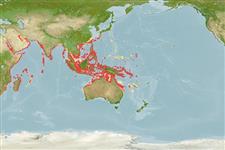
морской ассоциированный с рифами; немигрирующий; пределы глубины 0 - 50 m (Ref. 402). Tropical; 31°N - 28°S, 32°E - 167°E (Ref. 402)
Indo-West Pacific: Red Sea, Persian Gulf and East Africa to the Solomon Islands, north to southern Japan.
Размер / Вес / Возраст
половая зрелость: Lm ? range ? - ? cm
Max length : 40.0 cm TL самец/пол неопределен; (Ref. 402)
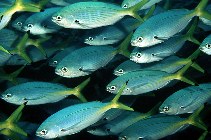
колючие лучи спинного плавника (общее число) : 10; членистые (мягкие) лучи спинного плавника (общее число) : 13 - 15; колючие лучи анального плавника: 3; членистые (мягкие) лучи анального плавника: 10 - 11. This species is distinguished by the following characters: a single postmaxillary process; D X, usually 14 soft rays; A III, usually 11soft rays; supratemporal band of scales generally interrupted at dorsal midline by a narrow scaleless zone; lateral line scales modally 49; scales above lateral line to dorsal -fin origin 7-10 (modally 8), below lateral line to anal-fin origin 14-19; predorsal scales 20-26; greatest body depth 2.2-3.1 in SL, head length 2.7-3.4 in SL; colour of body bluish, belly paler than upper sides; tips of caudal fin lobes, axil of pectoral fins, and upper base of pectoral fins black; caudal fin blue (except in juveniles where caudal fin and portions of caudal peduncle often yellow); pectoral, pelvic, and anal fins white to pale blue (pink or reddish after death); dorsal fin bluish (Ref. 68703, 90102).
Body shape (shape guide): fusiform / normal; Cross section: compressed.
Adults are found in coastal areas, mainly on or near coral reefs (Ref. 30573). They are more common along steep seaward reefs than in lagoons (Ref. 9710). They form large aggregations in midwater on upper edge of steep slopes and around patch reefs, often with other fusiliers (Ref. 90102). They feed on zooplankton. Are oviparous, with numerous, small pelagic eggs (Ref. 402).
Жизненный цикл и брачное поведение
половая зрелость | размножение | нерест | икра | Плодовитость | личинки
Carpenter, K.E., 1987. Revision of the Indo-Pacific fish family Caesionidae (Lutjanoidea), with descriptions of five new species. Indo-Pac. Fish. (15):56 p. (Ref. 1723)
Статус Красного Списка МСОП (Ref. 130435: Version 2025-2 (Global))
Угроза для людей
Harmless
Использование человеком
рыболовство: не имеет хозяйственного значения
дополнительная информация
инструменты
Специальные отчеты
Скачать в формате XML
ресурсы в Интернет
Оценки, основанные на моделях
Предпочтительная температура (ссылка
123201): 24.7 - 29.2, mean 28.2 °C (based on 1494 cells).
Индекс филогенетического разнообразия (ссылка
82804): PD
50 = 0.5010 [Uniqueness, from 0.5 = low to 2.0 = high].
Bayesian length-weight: a=0.01585 (0.00820 - 0.03063), b=3.08 (2.91 - 3.25), in cm total length, based on LWR estimates for this species & (Sub)family-body (Ref.
93245).
Трофический уровень (ссылка
69278): 3.4 ±0.45 se; based on food items.
устойчивость к внешним воздействиям (ссылка
120179): средний (среднего размера), минимальное время удвоения популяции 1.4-4.4 года (Preliminary K or Fecundity.).
Уязвимость рыбной ловли (Ref.
59153): Low to moderate vulnerability (30 of 100).
🛈
Питательные вещества (Ref.
124155): Calcium = 53.2 [35.4, 76.6] mg/100g; Iron = 0.708 [0.466, 1.023] mg/100g; Protein = 19 [18, 20] %; Omega3 = 0.138 [0.096, 0.196] g/100g; Selenium = 33.1 [21.1, 55.5] μg/100g; VitaminA = 99.1 [41.3, 244.0] μg/100g; Zinc = 1.1 [0.8, 1.5] mg/100g (wet weight);