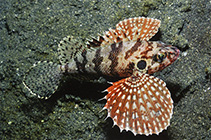
Ambiente: milieu / zona climatica / distribuzione batimetrica / gamma di distribuzione
Ecologia
marino demersale. Tropical
Northwestern Pacific: from South China Sea north to southern Japan, including the Natuna Islands, Borneo, the Gulf of Thailand, Ng Tran Bay, Vietnam and Taiwan.
Dimensione / Peso / Età
Maturità: Lm ? range ? - ? cm
Max length : 15.0 cm TL maschio/sesso non determinato; (Ref. 121532); peso massimo pubblicato: 29.00 g (Ref. 121532)
Spine dorsali (totale) : 13; Raggi dorsali molli (totale) : 10 - 11; Spine anali: 3; Raggi anali molli: 5 - 6. This species is distinguished by the following set of characters: pectoral-fin rays 14-16 (modally 15); scale rows in longitudinal series 44-51 (47); scales above lateral line 4-6 (5); scale rows between last dorsal spine base and lateral line 4-7 (6); pre-dorsal scale rows 4-8 (5); suborbital scale rows 0-4 (2); total gill rakers 15-19 (17); head length 38.3-43.1 (mean 40.2) %SL; orbit diameter 11.1-14.5 (12.4) %SL; upper-jaw length 18.6-21.5 (20.2) %SL; length of longest dorsal-fin soft ray 18.0-23.0 (20.2) %SL; length of longest anal-fin soft ray 21.0-27.0 (23.7) %SL; caudal-fin length 30.4-44.7 (35.7) %SL; posterior lacrimal spine usually directed posteriorly, not curved upward distally; spine(s) on corner of outer angular ridge not developed, size similar to other spines on ridge, directed ventrally; spines often absent on median lateral ridge of maxilla, rarely 1-3 spines present in large adults (>80 mm SL); a large number of small spots on caudal fin, 5-26 (mean 13.3) spots on longest caudal-fin ray (Ref. 93969).
Body shape (shape guide): fusiform / normal.
Lives in muddy habitat that are very sheltered and this is usually deep or very sheltered estuaries. Appears to be one of the more primitive forms and has similar coloration to some members of the genus Scorpaenodes, especially the markings on the head (Ref. 48635). Sometimes caught by trawl net (Ref. 559).
Ciclo vitale e comportamento di accoppiamento
Maturità | Riproduzione | Deposizione | Uova | Fecondità | Larve
Matsunuma, M., M. Sakurai and H. Motomura, 2013. Revision of the Indo-West Pacific genus Brachypterois (Scorpaenidae: Pteroinae), with description of a new species from northeastern Australia. Zootaxa 3693:401-440. (Ref. 93969)
Stato della Lista Rossa IUCN (Ref. 130435: Version 2025-2 (Global))
Minaccia per l'uomo
Harmless
Usi umani
Pesca: bycatch
Strumenti
Rapporti speciali
Scarica XML
Fonti Internet
Stime basate su modelli
Temperatura preferita (Fonte Biblio.
123201): 21.8 - 29.1, mean 28 °C (based on 446 cells).
Indice di diversità filogenetica (Fonte Biblio.
82804): PD
50 = 0.6250 [Uniqueness, from 0.5 = low to 2.0 = high].
Bayesian length-weight: a=0.01175 (0.00589 - 0.02344), b=2.97 (2.79 - 3.15), in cm total length, based on LWR estimates for this species & (Sub)family-body (Ref.
93245).
Livello trofico (Fonte Biblio.
69278): 3.7 ±0.6 se; based on size and trophs of closest relatives
Resilienza (Fonte Biblio.
120179): Medio, tempo minimo di raddoppiamento della popolazione 1.4 - 4.4 anni (Preliminary K or Fecundity.).
Vulnerabilità della pesca (Ref.
59153): Low vulnerability (10 of 100).
🛈