>
Ovalentaria/misc (Various families in series Ovalentaria) >
Ambassidae (Asiatic glassfishes)
Etymology: Ambassis: Derived from Greek, anabasis = climbing up (Ref. 45335).
More on author: Günther.
Entorno: milieu / zona climática / rango de profundidad / gama de distribución
Ecología
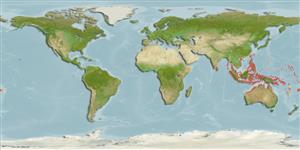
marino; agua dulce; salobre demersal; anfidromo (Ref. 138274); rango de profundidad 0 - 2 m (Ref. 86942). Tropical; 26°N - 27°S, 75°E - 172°W
Indo-Pacific: Arabian Sea and India, to Indonesia, Malaysia, East Timor, Taiwan, southern Japan, northern Australia, New Guinea, New Caledonia, Fiji, Samoa and the Cook Is.
Tamaño / Peso / Edad
Madurez: Lm ? range ? - ? cm
Max length : 10.3 cm TL macho / no sexado; (Ref. 7050)
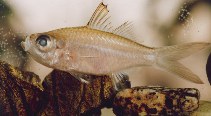
Espinas dorsales (total) : 8; Radios blandos dorsales (total) : 9 - 10; Espinas anales: 3; Radios blandos anales: 9 - 10. Resembles A. urotaenia, but differs in having large eye, and a gently-rounded snout. Eye diameter over 30% and interorbital width over 20% of head length. Cheek scales in 2 rows. Attains 8 cm TL.
Body shape (shape guide): fusiform / normal; Cross section: compressed.
Adults inhabit clear, flowing creeks, usually within 20 kilometers of the sea (Refs. 44894). Commonly found in brackish waters and river mouths near mangroves, stagnant and running freshwater (Ref. 7300) and coastal areas (Ref. 45255). This species has a marine larval stage, judging from its broad distribution. One of the best viewing areas is at the Freshwater creek picnic ground in Cairns, where individuals frequently aggregate along the vegetated stream margin (Ref. 44894).
Ciclo vital y comportamiento de apareamiento
Madurez | Reproducción | Puesta | Huevos | Fecundidad | Larva
Paxton, J.R., D.F. Hoese, G.R. Allen and J.E. Hanley, 1989. Pisces. Petromyzontidae to Carangidae. Zoological Catalogue of Australia, Vol. 7. Australian Government Publishing Service, Canberra, 665 p. (Ref. 7300)
Situación en la Lista Roja de la UICN (Ref. 130435: Version 2025-2 (Global))
Amenaza para el ser humano
Harmless
Usos humanos
Herramientas
Informes especiales
Descargar XML
Fuentes de Internet
Estimaciones basadas en modelos
Temperatura preferida (Referencia
123201): 26.2 - 29.3, mean 28.7 °C (based on 1629 cells).
Índice de diversidad filogenética (Referencia
82804): PD
50 = 0.5000 [Uniqueness, from 0.5 = low to 2.0 = high].
Bayesian length-weight: a=0.01202 (0.00494 - 0.02925), b=3.02 (2.83 - 3.21), in cm total length, based on LWR estimates for this Genus-body shape (Ref.
93245).
Nivel trófico (Referencia
69278): 3.5 ±0.41 se; based on food items.
Resiliencia (Referencia
120179): Alto, población duplicada en un tiempo mínimo inferior a 15 meses (Assuming Fec > 10,000).
Vulnerabilidad pesquera (Ref.
59153): Low vulnerability (10 of 100).
🛈