Entorno: milieu / zona climática / rango de profundidad / gama de distribución
Ecología
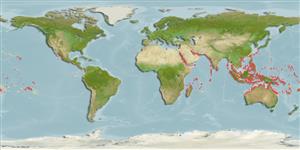
marino asociado a arrecife; rango de profundidad 1 - 15 m (Ref. 90102). Tropical; 30°N - 24°S
Indo-West Pacific: Maldives (Ref. 30829) and Mauritius to Indonesia, Singapore, the Philippines, Papua New Guinea and the Solomon Islands. Recently reported from New Caledonia (Ref. 11889).
Tamaño / Peso / Edad
Madurez: Lm ? range ? - ? cm
Max length : 15.0 cm TL macho / no sexado; (Ref. 48635)
Descripción breve
Claves de identificación | Morfología | Morfometría
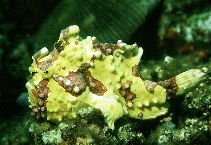
Espinas dorsales (total) : 3; Radios blandos dorsales (total) : 11 - 12; Espinas anales: 0; Radios blandos anales: 6 - 7. Characterized by numerous prominent wart-like protuberances on its skin and a large esca that mimics a tiny fish. Bony part of the illicium with numerous crossbands and approximately twice as long as the 2nd dorsal spine. Coloration is highly variable, ranging from cream to yellow, brown, or black with scattered dark circular spots and saddles or blotches ranging from white to pink, rust-red, or red. Heavily spotted individuals resemble A. pictus. Usually has red or orange margins on all fins and the first band across the body diverts to the posterior edge of the eye which distinguishes it from A. pictus (Ref. 48635).
Body shape (shape guide): short and / or deep; Cross section: compressed.
Inhabit sheltered rocky reefs (Ref. 559). Adults are usually with sponges (Ref. 48635). Juveniles openly on reefs looking like nudibranchs (Ref. 48635). Feeds on fishes (Ref. 89972). Oviparous. Eggs are bound in ribbon-like sheath or mass of gelatinous mucus called 'egg raft' or 'veil' (Ref. 6773). Solitary, frequently among algae, sponges and soft corals (Ref 90102).
Ciclo vital y comportamiento de apareamiento
Madurez | Reproducción | Puesta | Huevos | Fecundidad | Larva
Oviparous. Eggs are bound in ribbon-like sheath or mass of gelatinous mucus called 'egg raft' or 'veil' (Ref. 6773).
Pietsch, T.W. and D.B. Grobecker, 1987. Frogfishes of the world. Systematics, zoogeography, and behavioral ecology. Stanford University Press, Stanford, California. 420 p. (Ref. 6773)
Situación en la Lista Roja de la UICN (Ref. 130435: Version 2025-2 (Global))
Amenaza para el ser humano
Harmless
Usos humanos
Pesquerías: sin interés; Acuario: Comercial
Herramientas
Informes especiales
Descargar XML
Fuentes de Internet
Estimaciones basadas en modelos
Temperatura preferida (Referencia
123201): 25.2 - 29.3, mean 28.5 °C (based on 3049 cells).
Índice de diversidad filogenética (Referencia
82804): PD
50 = 0.5002 [Uniqueness, from 0.5 = low to 2.0 = high].
Bayesian length-weight: a=0.02692 (0.01067 - 0.06789), b=2.96 (2.73 - 3.19), in cm total length, based on LWR estimates for this (Sub)family-body shape (Ref.
93245).
Nivel trófico (Referencia
69278): 4.2 ±0.73 se; based on food items.
Resiliencia (Referencia
120179): Alto, población duplicada en un tiempo mínimo inferior a 15 meses (Fec assumed to be > 10,000).
Vulnerabilidad pesquera (Ref.
59153): Low vulnerability (10 of 100).
🛈