>
Siluriformes (Catfishes) >
Bagridae (Bagrid catfishes)
Etymology: Bagrus: Mozarabic, bagre, taken from Greek, pagros = a fish (Dentex sp.) (Ref. 45335).
Eponymy: Edward J E Degen (1852–1922) was a Swiss naturalist and ornithologist who lived and worked in Australia, Africa and England; he died in London. [...] (Ref. 128868), visit book page.
More on author: Boulenger.
Ambiente: milieu / zona climatica / distribuzione batimetrica / gamma di distribuzione
Ecologia
; acqua dolce demersale. Tropical; 1°N - 3°S
Africa: endemic to Lake Victoria (Ref. 51686, 58032).
Dimensione / Peso / Età
Maturità: Lm ? range ? - ? cm
Max length : 55.0 cm TL maschio/sesso non determinato; (Ref. 52118)
Breve descrizione
Chiavi di identificazione | Morfologia | Morfometria
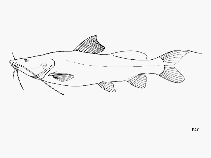
Spine dorsali (totale) : 1; Raggi dorsali molli (totale) : 9; Raggi anali molli: 12 - 13. Head much depressed, smooth above; long and narrow occipital processus, narrowly separated from interneural bone; snout broadly rounded, projecting beyond lower jaw (Ref. 2988). Eye iris dark, with a vivid yellow ring (Ref. 1568). Premaxillary band of teeth 6-7 times as long as broad, shorter than and as broad as or a little narrower than the vomerine band; maxillary barbel 1.25-2.33 times head length, extending to end of pectoral fin or a little beyond in adult, to end of ventral in young; nasal barbel 1/7(adult)-1/3 of head length; outer mandibular barbel 1.5-1.83 times length of inner and 0.5-1 times head length; gill-rakers rather long, widely set; dorsal spine smooth, less than 0.5 times head length; longest soft ray of dorsal fin 0.5-0.75 head length; adipose fin 4-5.5 times as long as deep, 1.5-1.66 times as long as dorsal fin; distance between dorsal and adipose fin 0.5-0.66 times dorsal fin length; pectoral spine not serrated in adult; caudal fin deeply forked, upper lobe with long filament (Ref. 2988).
Coloration: species blackish brown or dark steel-blue above, whitish or brassy yellow beneath with grey to blackish fins (Ref. 2988). Dark, nearly black on the back, fading into silver on the body, tinged with yellow (Ref. 36900).
Body shape (shape guide): elongated.
Caught in reeds and papyrus; feeds on small fish; grows up to 30-40 pounds (= 13-18kg); flesh is good and fish is of high economic importance (Ref. 36900).
Ciclo vitale e comportamento di accoppiamento
Maturità | Riproduzione | Deposizione | Uova | Fecondità | Larve
Jayaram, K.C., 1966. Contributions to the study of the fishes of the family bagridae. A systematic account of the African genera with a new classification of the family. Bull. I.F.A.N. (A) 28(3):1064-1139. (Ref. 51686)
Stato della Lista Rossa IUCN (Ref. 130435: Version 2025-2 (Global))
Minaccia per l'uomo
Harmless
Usi umani
Pesca: commerciale
Strumenti
Rapporti speciali
Scarica XML
Fonti Internet
Stime basate su modelli
Indice di diversità filogenetica (Fonte Biblio.
82804): PD
50 = 0.5005 [Uniqueness, from 0.5 = low to 2.0 = high].
Bayesian length-weight: a=0.00871 (0.00415 - 0.01826), b=2.93 (2.76 - 3.10), in cm total length, based on LWR estimates for this (Sub)family-body shape (Ref.
93245).
Livello trofico (Fonte Biblio.
69278): 4.2 ±0.73 se; based on food items.
Resilienza (Fonte Biblio.
120179): Alto, tempo minimo di raddoppiamento della popolazione meno di 15 mesi (Assuming Fec>10,000).
Vulnerabilità della pesca (Ref.
59153): Moderate vulnerability (42 of 100).
🛈